Get Podcast Updates to your Inbox

Want to increase energy & balance hormones?

If you're waking up tired, hitting a 2 PM wall or not recovering from workouts or stress like you used to, your cortisol patterns could be part of the picture. Get the simple, <10-min/day protocols I use to support cortisol, energy, sleep, and hormones, without overhauling your entire life. Especially helpful if it feels like your body has a mind of its own lately! 

Defensiveness, Coping & Managing Emotions with Dr. Stephanie Lopez

November 02, 2026•49 min read

✨ Feeling mentally scattered, overwhelmed, or like your brain just won't slow down? I've put together my tried-and-true tools for better mental clarity in Finally Focused: Mental Clarity on Demand. Grab it here: http://christabiegler.com/focus

🚨 BIG SAVINGS on Jaspr Air Scrubbers! Get $350 OFF NOW through December 31, 2026 with code LESSSTRESSED! Shop here: https://jaspr.co/lessstressed

Do you ever catch yourself overthinking, trying to keep everyone happy, or feeling like you need to control everything? On this episode of the Less Stressed Life, I'm joined by Dr. Stephanie Lopez to talk about how these everyday habits can actually be signs of defensiveness. Stephanie shares how a workshop during her career at NASA completely changed the way she understood her own emotions, and why coping with anxiety isn't always the same as addressing what's underneath it. We also get into how our nervous system plays a role in anxiety and some interesting ways to help calm it down. Plus, how learning to handle our own emotions can make a difference in our relationships, especially with our kids.

KEY TAKEAWAYS:

🛡️ Defensiveness beyond arguing
🧠 Overthinking, perfectionism, and people pleasing
💭 Coping vs. addressing anxiety
🌿 Calming an overactive nervous system
❤️ Emotional capacity and relationships


ABOUT GUEST:
Dr. Stephanie Lopez is an organizational psychologist, executive coach, and former NASA professional who helps high achievers overcome anxiety and overwhelm. After struggling with anxiety and burnout herself, a life-changing workshop inspired her to take a different approach to managing emotions. Today, Dr. Steph combines psychology, nervous system science, and practical tools to help women feel calmer, more confident, and connected in their everyday lives.

WHERE TO FIND GUEST:
Free Workshop: https://www.brave-method.com/anxiety-relief-experience
Instagram: https://www.instagram.com/drstephanielopez
Podcast: https://www.brave-method.com/anxiety-relief-experience

SPONSOR:
Thank you to Jigsaw Health for being such a great sponsor. 💛 I’m sharing some pretty cool health pearls 💎 about vitamin K2, a misunderstood nutrient that goes way beyond 🦴 bone health, including its role in helping calcium get where it needs to go, ❤️ cardiovascular health, 🥾 performance and more. Save 10% on any Jigsaw Health order with code LESSSTRESSED10.

NUTRITION PHILOSOPHY OF LESS STRESSED LIFE:
🍽️ Over restriction is dead
🥑 Whole food is soul food and fed is best
🔄 Sustainable, synergistic nutrition is in (the opposite of whack-a-mole supplementation & supplement graveyards)
🤝 You don’t have to figure it out alone
❤️ Do your best and leave the rest

WHERE TO FIND CHRISTA:
Website: https://www.christabiegler.com/
Instagram: @anti.inflammatory.nutritionist
Podcast Instagram: @lessstressedlife
YouTube: https://www.youtube.com/@lessstressedlife
Quick Links: https://www.christabiegler.com/links
Cortisol Shop: https://christabiegler.com/cortisol-shop

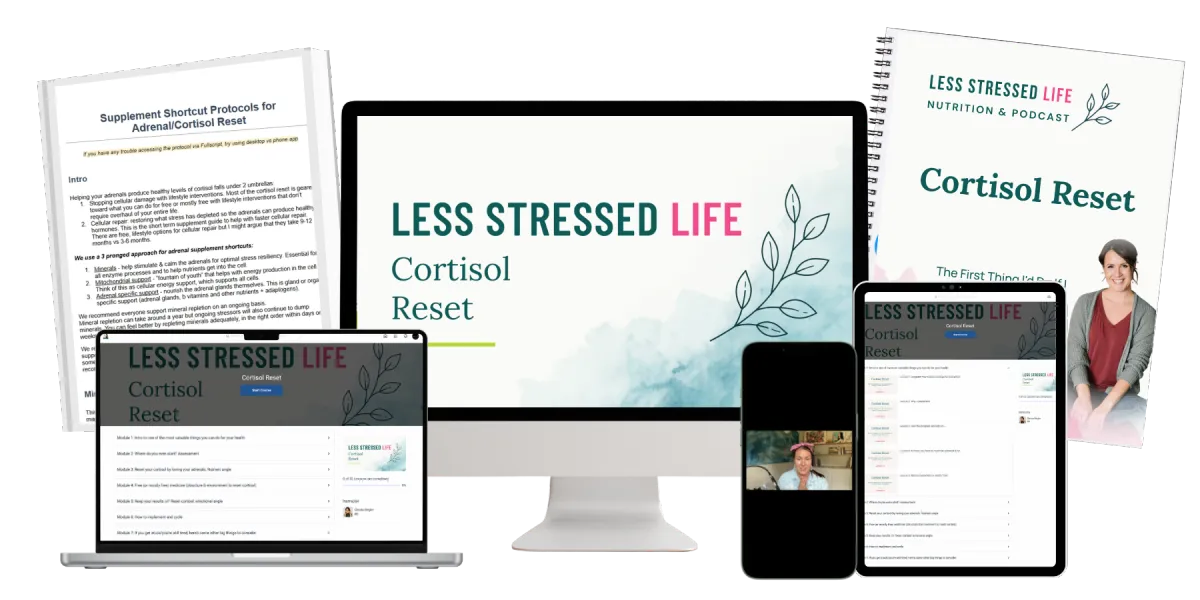
✨Grab Cortisol Reset here: https://christabiegler.com/cortisol-a

❓Questions for Christa? Submit them here: https://www.christabiegler.com/questions


Custom HTML/CSS/JavaScript

TRANSCRIPT:

[00:00:00] Dr. Stephanie Lopez: Every single one of us is defensive, quite literally, you could safely say every day, multiple times a day. And every single time that we're defensive, we are protecting ourselves from feeling our own insecurities and negative emotions.

[00:00:19] Dr. Stephanie Lopez: And so where there was a moment where I was going through this sheet that had signs of that you're being defensive, and I could quite literally check all of them, and there was over 40.

[00:00:32] Dr. Stephanie Lopez: And so as I looked at this list and I peeked next to the person beside me and they only had a few checks, I think mortified is, that's the word that comes to me. Holy cow, I have a lot of work to do. 

[00:00:46] Christa Biegler, RD: Welcome to the Less Stressed Life podcast. I'm your host, Christa Biegler, and we're in the ninth year of this show, and I just want to say thank you so much for being here. I'm personally in a season of wanting to pay it forward, to share everything I have learned from our clients over the last decade so that I can share it with as many people as possible in the next years, in the next decade.

[00:01:10] Christa Biegler, RD: I'd love to hear from you about what you want more of in the future, in the coming months of this podcast. Feel free to drop me a line at christabiegler.com/questions. Now, on to the show.

[00:01:22] Christa Biegler, RD: All right. 

Meet Dr Steph Lopez

[00:01:23] Christa Biegler, RD: Today on The Less Stress Life, I'm joined by Dr. Stephanie Lopez, who's an organizational psychologist, executive coach, and former NASA professional who helps high achievers break free from overwhelm and build real confidence in their careers and relationships. Despite outward success, a thriving NASA career, world travel, and a doctorate in psychology, Dr.

[00:01:41] Christa Biegler, RD: Steph privately struggled with anxiety and emotional overwhelm and burnout. A pivotal workshop and coaching experience changed everything, leading to two back-to-back $10,000 promotions and a complete shift in how she showed up for herself and others. Today, Dr. Steph combines psychology, nervous system science, and practical tools to help women move from survival mode to living with greater calm, confidence, and freedom.

[00:02:02] Christa Biegler, RD: Welcome to the show, Dr. Steph. 

[00:02:04] Dr. Stephanie Lopez: Thank you. So happy to be here, Krista. 

[00:02:07] Christa Biegler, RD: Yeah. I often meet people, interact with people in real life, go to conferences, and then they end up on the show, so that is how- Yeah ... I know Steph. And Maybe we'll get into some of these tools later that she uses, but people have so many different ways of approaching and supporting the same name, right?

[00:02:24] Christa Biegler, RD: So we're talking a little bit about anxiety today, but there's so many ways to go about it, and I thought she was doing some really novel, unique physical ways that we actually use our body's chemistry and our own feedback a little different than you might expect. But let's start with your story, and that bio opens us up to a little bit of curiosity.

[00:02:42] Christa Biegler, RD: This NASA career, all of these other things, it all sounds pretty cool. And now you're coaching these other I guess high achieving women, people that struggle with anxiety and we'll get more into that. But tell us a little bit about your story and how- Yeah ... things all unpacked for you.

[00:02:57] Dr. Stephanie Lopez: Absolutely. And right now I work with primarily women. I do sometimes get husband referrals or best- ... guy friend referrals. And maybe they're not... They don't identify as high achievers. And maybe they do, or maybe they're like, "Oh, when I was younger I did, but now I'm retired," and this and that.

[00:03:14] Dr. Stephanie Lopez: And so we can- ... talk more about that, too. But my story, I'm gonna start in the middle- 

... 

[00:03:19] Dr. Stephanie Lopez: Of my story. 

The NASA Workshop That Changed Everything

[00:03:20] Dr. Stephanie Lopez: Early in my career at NASA, I was invited to a workshop, and before that workshop, I was told a number of different things. It was a five-day experience, and I was told, "Oh, that's the crying class.

[00:03:35] Dr. Stephanie Lopez: People get divorced after that class." Oh, man, you're going to that? I don't know. And, "It's gonna change your life." And I was like, "What the heck am I about to walk into?" And I just decided I'm going to walk in with an open mind and see what happens. And when I walked through those doors, it was a white room with a circle of chairs in the center- Sort of had AA vibes.

[00:04:04] Dr. Stephanie Lopez: But this is- ... during work hours. It is not AA, not at all. And I sit down, and by noon of day one, I knew that this is what I wanted to do for the rest of my life. At that point, walking in there, I was already almost done with my dissertation, had my master's, almost done with, my PhD as a psychologist working with leadership, working with teams, and my life was changed so much in three hours- 

[00:04:38] Dr. Stephanie Lopez: That I immediately had clarity this is it. This is the answer to every question you have ever asked. Now I'm gonna go backwards. 

[00:04:47] Christa Biegler, RD: Yeah, those are big words. I can't wait to hear the- 

[00:04:49] Dr. Stephanie Lopez: Yeah ... 

[00:04:50] Christa Biegler, RD: more about this. 

[00:04:51] Dr. Stephanie Lopez: So I grew up in an environment where I had two emotionally immature parents. One let's see would shut down into deadly silence, and the other would go into aggression, criticizing.

[00:05:06] Dr. Stephanie Lopez: So one got big, one got small. And there's a lot more to say there, but what happened for me, just to keep it about myself, is that in hindsight, I felt broken. I felt like all of the emotions that I'm supposed to be feeling, I should not feel. And what that looked like on the outside was perfectionist tendencies, control, wanting things to be a certain way.

[00:05:35] Dr. Stephanie Lopez: And then on the inside, what that felt like was anxiety. And on the outside sometimes it was rage.

[00:05:44] Dr. Stephanie Lopez: And so I'm carrying much of this into that moment in 2013 that changed my life, and everything had already started to make sense. I'm gonna pause and just see where you take me. 

[00:06:01] Christa Biegler, RD: Yeah. I am so curious what some of what happened in that coaching experience, but I wanna first highlight and underline some of the things that you just said that are very resonant.

[00:06:10] Christa Biegler, RD: Yeah. So often, the clients I see in practice who are coming to me for physical things, they're addressing this physical things, but all of those ... I think as humans we're all just very similar, whether we think so or not. How we arrive at something, the circumstances might be a little bit unique to us.

[00:06:26] Christa Biegler, RD: Maybe I have two aggressive parents. Might be I have neither of those, but I may come out on the other side with some of these more vulnerable emotions are not safe. I've gotta control things. I've gotta manage the scenario. I've gotta be a perfectionist So I can manage- Try to

[00:06:41] Christa Biegler, RD: I can try to manage, everyone else's feelings. All of those things, the control, the perfection, the wanting things a certain way is 

[00:06:47] Dr. Stephanie Lopez: like- People pleasing tendencies 

[00:06:48] Christa Biegler, RD: Yeah. 

[00:06:48] Dr. Stephanie Lopez: Forgot to say that. Yeah. 

[00:06:49] Christa Biegler, RD: Yeah. These feel like the most resonant things And what's the challenge is you might start to recognize or identify as these things are here, but what do you do with it, right?

[00:07:01] Christa Biegler, RD: And there are multiple options probably on what to do with. There are different layers on how we can go about it, but I'm guessing you had already recognized that you had some of those tendencies and traits. It's interesting, what would your degree be called?

[00:07:13] Christa Biegler, RD: It's counseling essentially? Or- 

[00:07:14] Dr. Stephanie Lopez: I did psychology. Yeah. 

[00:07:15] Christa Biegler, RD: Yeah. How did you decide ... was there a part of your childhood or upbringing that you think pushed you in that direction? I'm curious as well. 

[00:07:23] Dr. Stephanie Lopez: Probably. Consciously what I decided was I think it was my first semester I was in, of college, I was in an intro to psychology class.

[00:07:31] Dr. Stephanie Lopez: At that point I was in pre-med- ... was the route that I was going. And I took this psychology class, and I couldn't stop thinking about it, and ... something in me was like, "You are supposed to go into psychology." A, a few details there is I wasn't allowed to do that. And so I had to get my mom's aunt to convince her that it was perfectly okay if I went and switched majors to psychology rather- Wow

[00:08:00] Dr. Stephanie Lopez: than going to, pre-med and medical school. Now, were there things that happened in my childhood that sparked an interest in psychology? 100%. the experiences that I had. Ultimately I'm thinking maybe this was under the surface in college, but I don't really know. Later for sure I was like, "I want To help people have the skills that they need so that they never feel broken like I did.

[00:08:31] Christa Biegler, RD: Do you think you could self-identify as feeling bro- like, at what point were you feeling, "I feel broken"? 'Cause I find that it's hard for us if we're trying to shove emotions down- Yeah ... it's hard for us to even sometimes name some of those things. I don't, yeah. We might not always say that, 

[00:08:43] Dr. Stephanie Lopez: I don't think that I did name that. Gosh, I wonder, I don't have a moment where I made that connection "Oh, I feel broken," but I think what I did know is I feel like something is flawed with me.

[00:08:56] Dr. Stephanie Lopez: And I did, I have a specific memory, I'm sure I had memories before this, where I was actually interviewing at NASA, and I was standing in a hallway waiting for the previous interviewee to finish.

[00:09:06] Dr. Stephanie Lopez: And I guess you could tell that I look nervous, and so two of the current, staff, they're like, "Oh," "How are you feeling?" And, "We're excited for you." And I was like, "Oh, I feel nervous." And they're like, "Oh, don't. Just be yourself." And that was the worst- ... for that version of me. The worst advice because- I didn't think who I was good. 

[00:09:29] Christa Biegler, RD: Yeah, that makes so much sense. 

[00:09:30] Dr. Stephanie Lopez: Yeah. 

[00:09:30] Christa Biegler, RD: That makes so much sense. It's like- 

[00:09:31] Dr. Stephanie Lopez: And I probably wouldn't have labeled it as like I'm pretending, but I was 100% pretending all the time that everything was good. 

[00:09:39] Christa Biegler, RD: Yeah. How would I be myself? What does that even mean?

[00:09:41] Christa Biegler, RD: Okay, I love that. 

From Suppressed Emotions to Anxiety Insight

[00:09:42] Christa Biegler, RD: But let's go back to the... We'll dig into some of the work and more about anxiety and how you started to know that was going on, this has come up a couple of times. It's like you have great gut feelings. 

[00:09:54] Christa Biegler, RD: You have very good, you're like, "I knew that this is what I was going to be."

[00:09:58] Christa Biegler, RD: that's a incredible trait because so often I feel like that's not the automatic norm at all. And so it's like I knew that this is what I wanted to do. And what a gift to have that opportunity to find that in your daily work . So often people are 

[00:10:14] Dr. Stephanie Lopez: like- I feel so lucky

[00:10:15] Christa Biegler, RD: I feel like people go to work and they're like, "I know I don't wanna be doing this, but I don't know what I'm supposed to be doing." So tell us a little bit about what unfolded in the crying workshop or the divorce workshop- . What were some of the things that really stuck with you that you were like- "oh, this is what," and then it changed the trajectory of your work? 

[00:10:29] Dr. Stephanie Lopez: Yeah. At this point, this is 13 years ago, so the essence stuck with me, not necessarily the exact words. But one of the things that I know for sure that was shared before noon was how parents... And this is a workshop this was just a little snippet that she included.

[00:10:48] Dr. Stephanie Lopez: This was for- ... teens, for individual- ... performance, but she, the facilitator shared how parents regularly and routinely cut off- the cycle of the emotion for their children. And immediately I felt like everything in my body that is what had been happening to me for my entire life.

[00:11:10] Dr. Stephanie Lopez: It was not okay for me to feel anything negative. 

[00:11:15] Dr. Stephanie Lopez: To the point where I was given not prescribed for me, medication to stop the emotion. 

[00:11:23] Dr. Stephanie Lopez: Okay? do you have a... Yeah. 

[00:11:25] Christa Biegler, RD: No, I was just gonna say that this is a very common resonant thing because parents don't want to see their children suffer.

[00:11:33] Dr. Stephanie Lopez: Yeah. 

[00:11:33] Christa Biegler, RD: And it may be their own stuff as well, of course. There could be multiple reasons. Oh, 

[00:11:36] Dr. Stephanie Lopez: it's 100% their stuff. 

[00:11:38] Christa Biegler, RD: Yeah. Yeah. They're like- Yes ... "I don't wanna see this child in pain, so let me give them everything to not be in pain." Yeah. But this is a very common thing that I sometimes see.

[00:11:45] Christa Biegler, RD: I would've been unaware of it probably to an extent if I hadn't been made aware by what happens on my social media feed, I think. It's oh- Yeah ... as parents, we do try to prevent our child from feeling pain or feeling harm, right? They fall down and they scrape their leg, and it's "Oh, let me kiss..."

[00:12:01] Christa Biegler, RD: And I'm not saying it's like But it's, there was more, obviously what you were describing. You're like, "It was more than that," right? It's like- 

[00:12:07] Dr. Stephanie Lopez: Yeah ... 

[00:12:07] Christa Biegler, RD: "don't cry," right? It's like, "You'll be fine. Buck up," type of thing is what I assume. No 

[00:12:12] Dr. Stephanie Lopez: anxiety, no frustration, no anger, no sadness.

[00:12:15] Dr. Stephanie Lopez: Just suppress, suppress. Stop. Yeah. Never was the word suppress used. Okay. But it was just like, "Don't have that." So then as a child, I concluded if I have all these things happening, something must be wrong with me." Yeah. Yeah. Like, why can't I keep it- yeah ... in and- yeah

[00:12:30] Dr. Stephanie Lopez: keep it stopped? Yeah. And so that's one thing. And then as the days went on, there was more and more, and another huge thing that changed everything for me was- It's something being distilled into a very simple concept that is happening for every single person, and it's defensiveness.

[00:12:52] Dr. Stephanie Lopez: Every single one of us is defensive, quite literally, you could safely say every day, multiple times a day. And every single time that we're defensive, we are protecting ourselves from feeling our own insecurities and negative emotions.

[00:13:11] Dr. Stephanie Lopez: And so where there was a moment where I was going through this sheet that had signs of

[00:13:18] Dr. Stephanie Lopez: that you're being defensive, and I could quite literally check all of them, and there was over 40.

[00:13:25] Dr. Stephanie Lopez: And so as I looked at this list and I peeked next to the person beside me and they only had a few checks, I felt probably, I think mortified is, that's the word that comes to me. Holy cow, I have a lot of work to do.

[00:13:39] Dr. Stephanie Lopez: But also, everything is really beginning to finally make sense in a way that it never did before. 

[00:13:47] Dr. Stephanie Lopez: Every single time I, and everyone around me who has done these things, for example, people pleasing Being overly critical, using humor to diffuse a situation, withdrawing into deadly silence overthinking- helping. That, that one has, is not always obviously, but there are times where it's coming from defensiveness. It was like, oh my God. I can't look at anything the same anymore. Anyway, so those are two things, there was more, but two things that really just shifted.

[00:14:23] Christa Biegler, RD: Yeah. You never felt so seen in your life, and also mortified, right? Mortified- Yeah ... but also seen, and it was, here it was laid out on a platter before you. So then what happened? You leave this workshop and you're still at your job, and how does this transition start? How did you- start to step into some of this? And some of this, as you describe it, it's both resonant, and then also sharing it with others can be a little bit ambiguous, right? Because I think that so often we don't always resonate with saying... if you walk up to someone... Okay, for example, when I started using coaching modalities in my work, you would start at the top and people would have some kind of overwhelm or overthinking version, and then eventually it boils down to fear and worthiness.

[00:15:06] Christa Biegler, RD: But people don't come in the door and say "I feel unworthy." They're like, that, "That's not it," right? And so people wouldn't come in the door and say "I feel defensive." But this checklist of- They don't 

[00:15:13] Dr. Stephanie Lopez: know ... 

[00:15:13] Christa Biegler, RD: exactly. They- They have no 

[00:15:14] Dr. Stephanie Lopez: idea. 

[00:15:15] Christa Biegler, RD: Exactly. So talk to us about what happened next just in general for you. How did this- My journey ... unfold? Yeah. How did this- 

[00:15:22] Dr. Stephanie Lopez: Yeah ... unfold 

[00:15:22] Christa Biegler, RD: more? 

[00:15:23] Dr. Stephanie Lopez: Yeah. 

Leaving NASA and Reframing Anxiety

[00:15:24] Dr. Stephanie Lopez: So I went about my merry little day and I started attempting to use what I learned with no guidance. 

[00:15:35] Dr. Stephanie Lopez: And, same role at NASA, and then I got certified as a coach, so then I was doing more official coaching for leadership and high performers.

[00:15:44] Dr. Stephanie Lopez: And then something in me was like, "You have got to get certified, licensed in this method." And so I did. And then I started using it more. Then I started hosting identical workshops at NASA in, rather than, bringing in somebody from the outside, then I started doing it there. One after facilitating one, I walked out and my coworker was out there and she asked how it went, and I was like, "Oh my gosh, it was amazing.

[00:16:13] Dr. Stephanie Lopez: I just love it so much." And she just saw the shift in my energy and she's like, "Steph," "why don't you just do that?" And it planted a seed.

[00:16:22] Dr. Stephanie Lopez: NASA's not a place that very many people leave.

[00:16:26] Dr. Stephanie Lopez: It's the best place to work in the federal government year after year.

[00:16:29] Dr. Stephanie Lopez: It's incredible, and I just assumed I will- 

[00:16:33] Christa Biegler, RD: Be a lifer ... 

[00:16:34] Dr. Stephanie Lopez: rise, rise to the top in leadership, be, SES, one of the, directors and then maybe I'll do this after I retire And 2020 came around, and I had my second baby in March, and something in me just switched. It was rough postpartum with my two-year-old home and the baby and not sleeping and all the emotions and this and that, and not having, the support that I wanted, and friends, family not being able to visit, all these things.

[00:17:11] Dr. Stephanie Lopez: And I decided when my baby was 12 weeks old, that I was starting a business. And it was something I had thought about "Oh, maybe it would be nice to start my own business before my oldest is in kindergarten. That way I can have more flexibility." And I just decided to. And so I left NASA end of January 2021 and never looked back.

[00:17:38] Christa Biegler, RD: Allow me to interrupt this episode to share about a misunderstood nutrient that has given me some really cool results, and that's vitamin K2. Now, most people only know about vitamin K1 because of its blood clotting abilities, but vitamin K2 is a totally different animal. Vitamin K2 is known for bone health, but there's also a number of studies that show how useful it is in cardiovascular health and improving cardiac output in athletes, so in other words, performance.

[00:18:03] Christa Biegler, RD: With those mechanisms in mind, I started vitamin K2 before a high elevation hiking trip and had zero altitude sickness. The other thing I've used it for is sluggish thyroid. For years, I've seen calcium stuck in the tissue on hair tissue mineral analysis testing with sluggish thyroid clients, including myself.

[00:18:21] Christa Biegler, RD: Vitamin K2 is one of the most important nutrients to help calcium get where it needs to go instead of impairing thyroid function. This is a very mineral-specific nuance that can make a big difference if you don't wanna have relapsing gut issues from the sluggish motility that comes along with this subclinical sluggish thyroid issue situation that is very rampant, very common.

[00:18:42] Christa Biegler, RD: Jigsaw Health has a vitamin K2 plus E complex marketed for bone health, but that vitamin E will support the cell membrane so the nutrients can get into the cell. So it's a very nice two-for-one product, but I would also do two caps of this product, as a lot of the health benefits associated with vitamin K2 are for 100 micrograms.

[00:19:00] Christa Biegler, RD: So two caps of Jigsaw's vitamin K2 plus E is gonna get you there. You can get 10% off of any order at jigsawhealth.com with the code LESSSTRESSED10. Any time, any place, repeat orders, code LESSSTRESSED10.

[00:19:16] Christa Biegler, RD: I love a good pivot story. You know, If I was ever going to shift any direction of this podcast, I'd be like, "Just tell me all your pivot stories." Yeah. Because so often people give up really dramatic things, right? For you, it's this, this elite career, right? That everyone else would kill to have overall.

[00:19:33] Christa Biegler, RD: And very often that keeps us where we are because we feel guilty, right? It's against our people pleasing qualities. We feel like we have to do what's the good or right thing often. And for you it was this like, "Ah, I have this perfect, on paper career." So pivot stories are my favorite, and what I'm hearing is really this a real tangible example of zone of excellence to zone of genius work, right?

[00:19:56] Christa Biegler, RD: And also what's so resonant is so often we have something that happens in our own journey that shifts and changes us in such a way that then we start to help others with it. It's a very common thing- 

[00:20:08] Dr. Stephanie Lopez: Yeah ... 

[00:20:08] Christa Biegler, RD: that happens. It is. Yeah. And it's a beautiful thing. It's a beautiful thing, right?

[00:20:12] Christa Biegler, RD: It's like it's a reminder that our most challenging times... I remember going through one of my first healing crises, and it's like a reminder in our most challenging times, whether we like the thought or not, is you know- The greatest growth ... it's this gift of maybe at some point there's some part of this that will help someone else, right?

[00:20:27] Christa Biegler, RD: That's like what we're all doing on this little Earth. Okay, so zone of excellence to zone of genius. Zone of excellence is where people, like you're very good at it. You can stay there. A lot of people will die there like half fulfilled. Yeah. It's like this zone of it's a little bit de-energizing at the end of the day, whereas zone of genius is like the flow state. Yeah. It's like, "Oh, all day I'm energized by this overall," et cetera. So anyway, that's how you feel like a very tangible example.

[00:20:52] Christa Biegler, RD: So things, what really stuck out to you in that workshop was these A couple of the things that you named were how parents influence their children, and so that's a bit of a tangent and a rabbit hole we could go down.

[00:21:04] Christa Biegler, RD: You talked about the defensiveness piece. But I believe that now, I believe that your front-facing term or marketing is around anxiety. And so I'm curious, in your own story, as a person who suppressed was taught, I guess taught to suppress emotions- Yeah ... in all forms- Yep ... when were you able to name anxiety overall?

[00:21:26] Christa Biegler, RD: Because I feel like very often something that's interesting to me is that sometimes we have to give people multiple words- Yeah ... for things. We don't always resonate. Just this morning I was sharing something with someone, and she didn't resonate with the word needing energy, but she needs a nap in the afternoon.

[00:21:40] Christa Biegler, RD: It's really funny. 

[00:21:42] Dr. Stephanie Lopez: Yeah. 

[00:21:42] Christa Biegler, RD: Yeah. It's like you have to describe things different ways. Yes. So when were you able to start to name anxiety- Yeah ... as an issue for yourself? How did that become the forefront word overall? 

[00:21:52] Dr. Stephanie Lopez: For a long time I think I w- referred to it as I'm a worrywart.

[00:21:58] Dr. Stephanie Lopez: And probably my mom said that to me. I don't know for sure, but I'm assuming that I was told that I'm a worrier, I'm a worrywart. And by undergrad, I was in a psychology class, I can't remember which one and learned about generalized anxiety disorder, and the more that I learned about it, I was like, "Oh, that's me.

[00:22:24] Dr. Stephanie Lopez: Yeah, I struggle with anxiety." Like- ... but then I began to take it on as that's who I am. 

[00:22:30] Christa Biegler, RD: And- there's nothing you can do about it. This is my identity. 

[00:22:33] Dr. Stephanie Lopez: This is the way that I always remember being. I must have been born this way. What is there to really do about it, truly- if we're not just coping with it? And yeah, I think I kept that identity until I had this experience at NASA- ... that shifted everything for me. 

[00:22:58] Christa Biegler, RD: You saw opportunity and possibility. 

[00:23:00] Dr. Stephanie Lopez: Opportunity and possibility, and a common thread that it all comes back to feeling your emotions. 

[00:23:08] Dr. Stephanie Lopez: And that so many of our problems are because we're not. 

[00:23:12] Christa Biegler, RD: I love that. I love that's the bottom line or the through line overall. Okay, there's some things I want to... I was gonna ask you about the difference between coping and actually helping. Does it feel accurate to say that you no longer have anxiety?

[00:23:29] Christa Biegler, RD: Do you feel like you always have anxiety and you learn to work through some... Like, what has that looked like from your journey? And then we'll kinda talk about how that's looked in your work overall. You identify as someone with anxiety I'm just stuck here. I see that a lot, right?

Identity and Possibility

[00:23:41] Christa Biegler, RD: Where it's like- ... people love to have an identity, right? We're all looking for an identity at some point. It's like one of the things of humanity. And so when we find that, it's like this is just how it is, right? Yeah. I am a human who's a questioner. 

[00:23:56] Dr. Stephanie Lopez: Yeah. 

[00:23:56] Christa Biegler, RD: So I'm always like, "Do you have to?"

[00:23:58] Christa Biegler, RD: Yeah. "Is that the only option? Is there any other options?" And then I think that we cannot see beyond our box, right? Like- Yeah ... so we cannot see outside of something we haven't seen before. We don't know- ... that something is possible unless we've seen the possibility.

[00:24:10] Christa Biegler, RD: So I often find that this podcast is a lot about stories of possibility, or what is possible or to hope in someone's mind.

[00:24:16] Christa Biegler, RD: At least that's my hope in general. So for you, you had this identity. You saw something was possible with this workshop. Yeah. And so then what happened with your own anxiety? Would you still identify as having anxiety? Basically, the question's really the difference- Yeah

[00:24:29] Christa Biegler, RD: between coping and whatever you would call what you do with anxiety now. ' I don't know if you call it managing. So walk us- Yeah ... through that a little bit. 

[00:24:35] Dr. Stephanie Lopez: Yeah. Okay. 

Coping vs Overcoming Anxiety

[00:24:36] Dr. Stephanie Lopez: So to answer the coping question, when I get clients that have been trying to cope, they've been given methods to manage anxiety- and/or panic attacks. ... And some of the things to some people might sound silly. Oh if you feel like you're about to have a panic attack, snap a rubber band on your wrist- ... or chew on a Jolly Rancher. Or some of these very surface level Band-Aid type situations, and that's how I look at, I know those are just two small examples.

[00:25:06] Dr. Stephanie Lopez: That's how I look at coping.

[00:25:08] Dr. Stephanie Lopez: Okay? And so sometimes the way that people cope is they avoid. I just won't do the thing that triggers me," which actually just makes it a whole lot worse- ... and we can talk about that if we have time today. And so what we want to do is overcome- Daily anxiety.

[00:25:30] Dr. Stephanie Lopez: You're a human who is here to feel all the things. Are there going to be moments where you might have fear come up and you could label that as "Oh, I feel like anxious about this presentation that I'm about to do, or this social gathering that I'm about to go to"? Sure. Do we wanna be experiencing anxiety every single day, and do we have to experience it every single day?

[00:25:55] Dr. Stephanie Lopez: No. So I have some of my clients struggle with panic attacks, and they'll come in after struggling with panic attacks for 10, 20, 30, 40 years. They've been in therapy. They've tried all kinds of modalities, and then we eliminate the panic attacks. Even people having one to two panic attacks a day, get them off medication if they wanna be and eliminate the panic attacks.

[00:26:25] Dr. Stephanie Lopez: So happy to elaborate on any of that. For myself, I think you asked what this looked like for me, is essentially I was somebody who struggled with anxiety every day. Part of that is I had reoccurring breakdowns. Some people might label it as a panic attack. I think technically what I was experiencing was an emotional breakdown.

[00:26:46] Dr. Stephanie Lopez: I would end up hyperventilating. What often triggered me was feeling incapable or incompetent, and it would take me out for the day 

[00:26:57] Dr. Stephanie Lopez: ... and then go to sleep, and then be able to conquer everything the next day. 

[00:27:04] Christa Biegler, RD: Yeah. It's really helpful to get some of those tangible examples, right? 'Cause so often we may not say.

[00:27:09] Christa Biegler, RD: So you, I feel, help people not cope with anxiety, but be someone... It's really a difference between you might experience anxiety, and I have options for that, versus- Yeah ... I have anxiety as an identity. And so very often people come in with these coping tools, and how does it look, what were some of the things that you started implementing with clients- Yeah

[00:27:33] Christa Biegler, RD: That kind of really started to shift out of coping and more of we're eliminating panic attacks now? 

[00:27:39] Dr. Stephanie Lopez: Yeah. Yeah. Okay. 

Biofeedback Breathwork Protocol

[00:27:41] Dr. Stephanie Lopez: Very first thing that I do when clients come in is we start with the body. So at a high level, what I'm looking to do is turn down the sensitivity setting of their nervous system. So if you think about a smoke alarm, and a regular smoke alarm is really only going off if there's smoke.

[00:28:00] Dr. Stephanie Lopez: But if a smoke alarm is too sensitive, it's going off if there's burnt toast.

[00:28:05] Dr. Stephanie Lopez: And so people that are really in fight or flight, that are struggling with anxiety, that are struggling with panic attacks e- basically every day maybe not the panic attacks every day, it could be their sensitivity setting is turned up, and so we wanna turn it down.

[00:28:20] Dr. Stephanie Lopez: The way that I love to do that is the opposite of what most approaches do. People that come into my world, they have been trying to approach it from the mind, thinking positive, telling themselves not to worry "Oh, I just need to get more confident," avoiding certain situations, telling themselves, "It'll be okay."

[00:28:41] Dr. Stephanie Lopez: Like, all the things from the mind, but the body reacts faster than the mind does, so we start with the body. And it's not just a generalized approach either, which is different for people, because can they look up like, "Oh, how can I regulate my nervous system?" Sure. But I take them through a 10-week protocol using data from their body.

[00:29:06] Dr. Stephanie Lopez: I literally ship them a sensor that they wear during a session to identify what is their optimal breathing rate based on data from their body. Then we use that optimal breathing rate during the 10 weeks. To turn down that sensitivity setting, to make their nervous system more flexible. So what I mean by that is the body's automatically gonna get activated.

[00:29:33] Dr. Stephanie Lopez: We never have to try to activate ourselves. It just does. What most people don't learn is, like, how do I come out of that activation? How do I do that effectively? And sometimes people will get stuck in that activation when they're, like, constant anxiety, panic attacks. And so when I say flexibility, we're making it, so that their nervous system can more easily deactivate And

[00:30:02] Dr. Stephanie Lopez: They're doing this protocol not just when they feel anxious, but it's when they feel calm as well, and taking them through specific things each week. 

[00:30:10] Christa Biegler, RD: I think that's actually the hard part is that I had been chewing on this for at least a couple of years, is that most people, or a lot of people would say "I don't feel stressed," or what I was chewing on was that the most challenging toxic thing we have in front of us is unconscious stress.

[00:30:28] Christa Biegler, RD: I can't even name it because it's such a baseline for me. And so I think it's really fun that you use biofeedback, biometrics- Yeah ... literally it's an HRV sensor basically- ... to help them. And there's all different types and whatnot, but I think that's really cool because what is I find most common is the people who really need any kind of work around this are v- usually overriding all sensation in general, right?

[00:30:54] Christa Biegler, RD: We've been overriding it for so long, we've built this hard shell that it's like, and there's really a resistance to feeling. If I even think- Oh ... of my own story before I got... accident, I joke that I accidentally got tricked into breathwork, and I was like, "What is this crap?

[00:31:08] Christa Biegler, RD: Why am I crying," right? So there's all these different body-based things. Yeah. I've had people say to... I was at a real estate retreat, and I did breathwork, and this woman said "I don't understand why I was crying." And it's yeah, it's like the body can respond. It's actually it's a mind boggle for all of us that spend all of our time in our head really logically.

[00:31:24] Christa Biegler, RD: Right? Makes sense. Yeah. But those are, like, speaking also from my own experience, it's like this is when we really need it. So I think this is such a fun, cool thing because it serves that exact issue- 

[00:31:37] Dr. Stephanie Lopez: Yeah ... 

[00:31:37] Christa Biegler, RD: that I find is most common. When did you feel like you needed to add that? I don't know if you started here, because I'm doubtful that you were doing that in that workshop, right?

[00:31:45] Christa Biegler, RD: And, you know- I was probably busy, yeah ... there was probably a part, a time where you added this. Yeah. At what point when you were working with clients did you add this, and why did you do that? 

[00:31:52] Dr. Stephanie Lopez: Yeah. Earlier when you pointed out like, "Oh, you just get these urges to do things, and then you do it out of seemingly nowhere suddenly," I was like, "I need to get breathwork certified."

[00:32:03] Dr. Stephanie Lopez: If you had asked me before that, I would've pooh-poohed breathwork and I didn't have a, an experience that changed my mind. That's the weird part. I didn't- It's not like I did it, and then it was great, so I, then I got certified. It was just like suddenly everything in me was like, "You have to do this."

[00:32:21] Dr. Stephanie Lopez: So I did, and it was one of the greatest gifts. And it's just, I think about it like co-creating with the universe, and I- Yeah ... I know that you can resonate with that, and it's just the more that I have let go of control, I was a control freak. The more I've let go of control, honored the intuition, honored the urges, the most magical and beautiful things have happened.

[00:32:47] Christa Biegler, RD: Yeah. Yeah. 

[00:32:47] Dr. Stephanie Lopez: Yeah. Yeah. 

[00:32:48] Christa Biegler, RD: Something I wanted to say, you were talking about the first step, is that you help them turn down their sensitivity because the sensitivity can be quite heightened. Yes. And I wanna share, I have for a long time come from a physical sense, right? People come to me for physical symptoms.

[00:33:02] Christa Biegler, RD: Yeah. But we see 100% how much this hyperactivation is literally creating these physical symptom- of course with you too. Yeah. But often as humans, we go to the thing that we think will make a difference first. So if you are reacting to foods, you're like let me go to someone who works- Yeah

[00:33:18] Christa Biegler, RD: on physical food stuff," right? And it's a million years ago when I started my career, I helped people restrict foods, but guess what that did? It turned up their hypersensitivity 'cause we weren't really addressing anything around the nervous system. Yeah. So we started to move into other things, and it's oh, I actually don't even need to do that to correct the food reaction.

[00:33:35] Christa Biegler, RD: It's like- Yes ... a mind boggle, right? Because if all information coming into the body stops being, like, essentially a cell danger response, right? 'Cause we've turned down the sensitivity everything gets better, right? 

[00:33:46] Dr. Stephanie Lopez: Everything. I had someone in my program recently share, she's like, "Holy cow, this program is so much more than anxiety," and she talked about her psoriasis- is resolved. And I don't ever mention anything like that. I don't make any promises around that. I have somebody who came in with a lot of wrist pain, carpal tunnel. Not an issue anymore. Chronic back pain at 65, and we're, that's, l- going down and down. The frequency- that pops up, it's less and less, and she's just been in just a few months. And so I'm with you, absolutely. 

[00:34:22] Christa Biegler, RD: Yeah. We've actually done multiple pain related to emotion episodes for this reason. And yeah, it'd be hard to convince me that's not... it's, we have words for this. I cannot even remember what it's called.

[00:34:34] Christa Biegler, RD: TMS. Tension myo- Yeah, thank you. Yes. TMS, tension myositis syndrome, right? Yeah. I think is what it is. Yeah it's fun. So I've worked with skin stuff for so long, and this, in ancient Eastern medicine is related to anger in the liver, et cetera. And so that's one of the least rewarding things is those of us with skin stuff often have some kind of repressed frustration or anger- related to things. And so- Yeah ... for me, for a long time I wanted to move toward working on stress hormone physiology and all of these other things. Yeah. And, So for, similarly to what happened to you, it's oh, this actually is nothing else really matters if this isn't tuned in some capacity, right?

[00:35:11] Christa Biegler, RD: There's a lot of skills that we have the opportunity to build and gain and practice and learn in our lives that we have no idea are gonna make our life 100% better. From- Yeah ... knowing that we've gotta do certain home maintenance things to-

[00:35:28] Christa Biegler, RD: how do we do the home maintenance on our nervous system, to all of- Yeah ... these, other things. That's a lot of skills. And I think that's maybe since the conversation somewhat started there. I think I remember I remember also I can't quite describe it as eloquently as you, but I remember starting to realize oh, my parents did the best that they could with what they had.

[00:35:51] Christa Biegler, RD: Yeah. And their parents did the best they could with what they have, and there was still a lot of challenges all the way down that keep getting handed down, and the more you try to, be different or better. And so when we hear this initial part of the story, it's like can be a little bit of a eyes wide open thing as a parent.

Parenting with Emotional Capacity

[00:36:09] Christa Biegler, RD: And so you're a parent now. I don't know how old your oldest is now. How has this changed parenting for you? What would be your advice for people who are listening to this who are like, "Oh, I feel like I have to get my life straight to help my own child so I'm not trying to accidentally suppress their own emotions"?

[00:36:27] Christa Biegler, RD: I feel like that's what really stuck out to me as you're telling this story. It- 

[00:36:30] Dr. Stephanie Lopez: Yeah ... 

[00:36:31] Dr. Stephanie Lopez: yeah. 

[00:36:31] Christa Biegler, RD: It's like this is an opportunity for us. So- what advice would you give to parents? 

[00:36:36] Dr. Stephanie Lopez: Okay. So my oldest is eight, so keep in mind that I'm speaking, from that age group. I have not been through the teenage years and all of that.

[00:36:46] Dr. Stephanie Lopez: And I had something happen recently with her that melted my heart and broke my heart at the same time. I'm getting a little teary-eyed thinking about it. We often go for a walk as a family, and I looked down at her and I said, "What's going on?" And she immediately opened up and started crying and said " You're the only one in the whole world that understands me.

[00:37:21] Dr. Stephanie Lopez: Everyone else doesn't want me to cry." And it was just coming from her mouth with so emotion and much gratitude for the safety that she felt

[00:37:35] Dr. Stephanie Lopez: Isn't something that we all want, to be able to be safe, to be our complete selves with at least one other person? And so when she did that, I felt sad that more people don't have these skills to be able to hold space. They don't have the emotional capacity. If someone's emotional capacity for sadness is, the size of a quarter, they're not gonna be able to hold space for anybody else that's sad.

[00:38:00] Dr. Stephanie Lopez: They're gonna try to make them feel better. And often, a defensive response comes from that. For example, when someone tried to make me feel better as a child, to make my emotions stop, they would last longer. What you resist will persist. And so- ... my goal is not to help her move through the emotional cycle as fast as possible, but because I'm able to hold space for her and I feel comfortable with the emotion, she actually does.

[00:38:31] Dr. Stephanie Lopez: It's quite brief. And so- ... the connection that we have together, the safety that she feels, the speed at which she's able to move through her emotions, the fact that she is able to tell me when she doesn't like something that I did or said, and I'm able to receive it in a way where I don't get defensive, where I listen- where I take accountability, where I apologize, where I repair, where I do better, what child, no matter what our age is, doesn't want that? 

[00:39:06] Christa Biegler, RD: Yeah.

[00:39:07] Christa Biegler, RD: Whether they could name it or not. 

[00:39:09] Dr. Stephanie Lopez: Yes. Yes. Yeah. How many times- on social media where someone said, I'm trying to talk to my mom about things that happened in childhood that really b- felt hurtful or brought up this emotion or that emotion," and the parent immediately shuts it down and doesn't apologize and doesn't give space, and then it's like disconnection.

[00:39:30] Dr. Stephanie Lopez: And like- Rather than wanting to be right, what if we focus on let me stay connected to this human and actually listen like it's not about me- 

... 

[00:39:38] Dr. Stephanie Lopez: For just a few minutes? 

[00:39:42] Christa Biegler, RD: Yeah. I think that I would love to underline and highlight that line for sure. And I love a good question, right?

[00:39:49] Christa Biegler, RD: What- 

[00:39:49] Dr. Stephanie Lopez: Yeah ... 

[00:39:50] Christa Biegler, RD: what if we focused on connection versus wanting to be right? Ooh, that is like a very... 'Cause instead of the word defensiveness, I think that like wanting to be right could be very resonant- 

[00:40:00] Dr. Stephanie Lopez: Oh, 

[00:40:00] Christa Biegler, RD: for sure ... for a lot of people. And I wanna underline or note something else, being comfortable with someone else.

[00:40:06] Christa Biegler, RD: It's like I used to be a very uncomfortable with someone else crying all the time. And so it's very interesting, right? 'Cause I did have the emotional capacity of a quarter. I would love for you to repeat that line. I was actually sharing that with my own daughter recently.

[00:40:20] Christa Biegler, RD: I was like, "I didn't have the space to hold for, my family's emotions when I was holding space for all of my clients' emotions when I hadn't even built the emotional capacity for myself." So could you repeat the line about having the emotional capacity of a quarter? 'Cause it kinda made me giggle a little bit.

[00:40:35] Christa Biegler, RD: But I just wanna make sure we hear that fully. 

[00:40:37] Dr. Stephanie Lopez: Yeah. When you have the emotional capacity of a quarter, let's just say for sadness, but it could be for any or all emotions, you cannot possibly hold space for other people in a greater capacity than that. So then what you'll probably do is shut it down, try to make them feel better, look for the silver lining- and all these things. And then when we pause and we think about how do we feel when somebody tries to make us feel better- 

... 

[00:41:07] Dr. Stephanie Lopez: If we are in the middle of the emotion alone, like they don't get it.

[00:41:13] Dr. Stephanie Lopez: All kinds of experiences like, oh I guess I can't open up to this person anymore. Like I don't feel understood, I don't feel heard, I don't feel seen, all the things, which what does that do to connection?

[00:41:27] Christa Biegler, RD: It doesn't make you feel connected at all. 

[00:41:28] Dr. Stephanie Lopez: Not at all. 

[00:41:29] Christa Biegler, RD: Yeah, the opposite. 

[00:41:31] Dr. Stephanie Lopez: Yeah. The opposite. And people will draw a number of different conclusions. Some people will conclude that it's that person. Some people will conclude that it's them, that they're just too sensitive- 

[00:41:40] Dr. Stephanie Lopez: ... or they should just get over it.

[00:41:42] Dr. Stephanie Lopez: Why are they even feeling this way? And, ... so various responses, but. 

Relationships Ripple Effect and Farewell

[00:41:45] Christa Biegler, RD: I feel like this is a bit of a loaded question, and I think that I could come back to focusing on connection versus wanting to be right. But since we ended up talking about children, I try to ask the questions that I feel like the audience member is also thinking, which...

[00:42:00] Christa Biegler, RD: 'Cause I find this 'cause in coaching we talk about how a relationship is like your thoughts about another person. And so you improve a relationship by just changing how you are projecting in general. But I can hear this but Dr. Stephanie, my partner or my spouse or my ex or my who, my current whatever what if I'm trying and this person is not?

[00:42:22] Christa Biegler, RD: 'Cause we ended up talking about kids. We, Yeah ... talked about self. I feel that one of our biggest stressors in life are often our relationship with ourselves and our relationship with others. And these are- very commonly for a lot of people the relationships that they're in all day, every day. And so we talked- Yeah ... a little bit about children. But what might you tell a listener who says, "But Dr. Stephanie, I can't do more than this other person," or I don't even know- Yeah.

[00:42:45] Christa Biegler, RD: Yeah ... how to phrase the question, but I just want you to speak to that a little bit as well. 

[00:42:48] Dr. Stephanie Lopez: Yeah. Yeah. I can never say this for 100%, because humans are not robots. They're not machines. They're people, and they respond differently. But what I can say with a great deal of certainty is that when you start with you, and you expand your tolerance for emotions, and you follow the framework to have non-defensive conversations, and you understand the meaning that your mind is making up all the time, they don't actually need to know any of those skills for the relationship to improve. I've had this experience myself, but my clients will come, and their relationships with their partners, with their nearly estranged parents, with their children change. Now, because we have mirror neurons, people pick things up.

[00:43:46] Dr. Stephanie Lopez: And then we can also share our learnings, and if they want to, they can start to incorporate it.

[00:43:51] Dr. Stephanie Lopez: But I will get pushback sometimes. People are like, "Don't they need to know?" And they don't. 

[00:43:56] Dr. Stephanie Lopez: And it's amazing. 

[00:43:58] Christa Biegler, RD: Yeah. I've had this experience as well. I'm try- I can't give you a, the perfect example, but what I can say is sometimes I've intentionally shifted something about how I was responding in a recurrent situation, and within three weeks I was like, "The tone of this household is totally different than when I started," right?

[00:44:16] Christa Biegler, RD: It was like I just did this very quiet experiment for myself, and I'm like, "Yep, I see the ripple effect in the household." Yes.

[00:44:23] Dr. Stephanie Lopez: Yeah. 

[00:44:23] Christa Biegler, RD: But, and so to emphasize that, it's it's like the oxygen mask, right? It's if you wanna help anyone in your life and in your family, the best thing you can do is make your own emotional capacity more than a quarter.

[00:44:33] Christa Biegler, RD: Just speaking from experience, right? 

[00:44:34] Dr. Stephanie Lopez: Yes. 

[00:44:35] Christa Biegler, RD: Yeah. 'Cause at worst case, at least you're gonna be able to breathe better. Yeah. At least you're gonna look better, and then that also ... I feel like when you're feeling better, your capacity is better as well. It's very bidirectional overall.

[00:44:47] Christa Biegler, RD: Is there a ... What would you wanna leave listeners with today, Dr. Se- We, I, it feels like a little bit of an abrupt thing, but we talked through a lot of pieces, right? Yeah, we did. We did. We talked about your story. Yeah. Talked about these pivotal moments and your gut feelings and to follow and how you deal how you help and support clients with more body-based versus top-down based approaches.

[00:45:07] Christa Biegler, RD: Yeah. And then really, I think so importantly, we talked a little bit about that affecting families, kids parents, et cetera. So what would you wanna leave a listener with, and then where can people find you online? 

[00:45:17] Dr. Stephanie Lopez: What do I wanna leave them with? If you happen to resonate with feeling flawed like I did, broken like I did, I want you to know it's not true.

[00:45:32] Dr. Stephanie Lopez: It's not like you, you might feel it, but there is a very concrete way that you can come out of this, and it does not have to feel painful. It doesn't have to... You don't have to suffer through it. And so if you wanna find me best place is Instagram, and my handle is @drstephanielopez, Dr. Stephanie Lopez.

[00:45:54] Dr. Stephanie Lopez: Same thing on Facebook. 

[00:45:57] Christa Biegler, RD: Yeah. Thanks so much for coming on today. 

[00:45:58] Dr. Stephanie Lopez: Thank you.

[00:45:59] Christa Biegler, RD: Thanks for listening to this week's show. For all the links mentioned in this episode, from submitting your questions and comments to picking up The Cortisol Reset or Finally Focused: Mental Clarity on Demand, you can find all of those links in the show notes below this episode. See you next week


Christa Biegler
Functional Medicine Nutritionist and Podcast Host
Back to Blog

Defensiveness, Coping & Managing Emotions with Dr. Stephanie Lopez

November 02, 2026•49 min read

✨ Feeling mentally scattered, overwhelmed, or like your brain just won't slow down? I've put together my tried-and-true tools for better mental clarity in Finally Focused: Mental Clarity on Demand. Grab it here: http://christabiegler.com/focus

🚨 BIG SAVINGS on Jaspr Air Scrubbers! Get $350 OFF NOW through December 31, 2026 with code LESSSTRESSED! Shop here: https://jaspr.co/lessstressed

Do you ever catch yourself overthinking, trying to keep everyone happy, or feeling like you need to control everything? On this episode of the Less Stressed Life, I'm joined by Dr. Stephanie Lopez to talk about how these everyday habits can actually be signs of defensiveness. Stephanie shares how a workshop during her career at NASA completely changed the way she understood her own emotions, and why coping with anxiety isn't always the same as addressing what's underneath it. We also get into how our nervous system plays a role in anxiety and some interesting ways to help calm it down. Plus, how learning to handle our own emotions can make a difference in our relationships, especially with our kids.

KEY TAKEAWAYS:

🛡️ Defensiveness beyond arguing
🧠 Overthinking, perfectionism, and people pleasing
💭 Coping vs. addressing anxiety
🌿 Calming an overactive nervous system
❤️ Emotional capacity and relationships


ABOUT GUEST:
Dr. Stephanie Lopez is an organizational psychologist, executive coach, and former NASA professional who helps high achievers overcome anxiety and overwhelm. After struggling with anxiety and burnout herself, a life-changing workshop inspired her to take a different approach to managing emotions. Today, Dr. Steph combines psychology, nervous system science, and practical tools to help women feel calmer, more confident, and connected in their everyday lives.

WHERE TO FIND GUEST:
Free Workshop: https://www.brave-method.com/anxiety-relief-experience
Instagram: https://www.instagram.com/drstephanielopez
Podcast: https://www.brave-method.com/anxiety-relief-experience

SPONSOR:
Thank you to Jigsaw Health for being such a great sponsor. 💛 I’m sharing some pretty cool health pearls 💎 about vitamin K2, a misunderstood nutrient that goes way beyond 🦴 bone health, including its role in helping calcium get where it needs to go, ❤️ cardiovascular health, 🥾 performance and more. Save 10% on any Jigsaw Health order with code LESSSTRESSED10.

NUTRITION PHILOSOPHY OF LESS STRESSED LIFE:
🍽️ Over restriction is dead
🥑 Whole food is soul food and fed is best
🔄 Sustainable, synergistic nutrition is in (the opposite of whack-a-mole supplementation & supplement graveyards)
🤝 You don’t have to figure it out alone
❤️ Do your best and leave the rest

WHERE TO FIND CHRISTA:
Website: https://www.christabiegler.com/
Instagram: @anti.inflammatory.nutritionist
Podcast Instagram: @lessstressedlife
YouTube: https://www.youtube.com/@lessstressedlife
Quick Links: https://www.christabiegler.com/links
Cortisol Shop: https://christabiegler.com/cortisol-shop

✨Grab Cortisol Reset here: https://christabiegler.com/cortisol-a

❓Questions for Christa? Submit them here: https://www.christabiegler.com/questions


Custom HTML/CSS/JavaScript

TRANSCRIPT:

[00:00:00] Dr. Stephanie Lopez: Every single one of us is defensive, quite literally, you could safely say every day, multiple times a day. And every single time that we're defensive, we are protecting ourselves from feeling our own insecurities and negative emotions.

[00:00:19] Dr. Stephanie Lopez: And so where there was a moment where I was going through this sheet that had signs of that you're being defensive, and I could quite literally check all of them, and there was over 40.

[00:00:32] Dr. Stephanie Lopez: And so as I looked at this list and I peeked next to the person beside me and they only had a few checks, I think mortified is, that's the word that comes to me. Holy cow, I have a lot of work to do. 

[00:00:46] Christa Biegler, RD: Welcome to the Less Stressed Life podcast. I'm your host, Christa Biegler, and we're in the ninth year of this show, and I just want to say thank you so much for being here. I'm personally in a season of wanting to pay it forward, to share everything I have learned from our clients over the last decade so that I can share it with as many people as possible in the next years, in the next decade.

[00:01:10] Christa Biegler, RD: I'd love to hear from you about what you want more of in the future, in the coming months of this podcast. Feel free to drop me a line at christabiegler.com/questions. Now, on to the show.

[00:01:22] Christa Biegler, RD: All right. 

Meet Dr Steph Lopez

[00:01:23] Christa Biegler, RD: Today on The Less Stress Life, I'm joined by Dr. Stephanie Lopez, who's an organizational psychologist, executive coach, and former NASA professional who helps high achievers break free from overwhelm and build real confidence in their careers and relationships. Despite outward success, a thriving NASA career, world travel, and a doctorate in psychology, Dr.

[00:01:41] Christa Biegler, RD: Steph privately struggled with anxiety and emotional overwhelm and burnout. A pivotal workshop and coaching experience changed everything, leading to two back-to-back $10,000 promotions and a complete shift in how she showed up for herself and others. Today, Dr. Steph combines psychology, nervous system science, and practical tools to help women move from survival mode to living with greater calm, confidence, and freedom.

[00:02:02] Christa Biegler, RD: Welcome to the show, Dr. Steph. 

[00:02:04] Dr. Stephanie Lopez: Thank you. So happy to be here, Krista. 

[00:02:07] Christa Biegler, RD: Yeah. I often meet people, interact with people in real life, go to conferences, and then they end up on the show, so that is how- Yeah ... I know Steph. And Maybe we'll get into some of these tools later that she uses, but people have so many different ways of approaching and supporting the same name, right?

[00:02:24] Christa Biegler, RD: So we're talking a little bit about anxiety today, but there's so many ways to go about it, and I thought she was doing some really novel, unique physical ways that we actually use our body's chemistry and our own feedback a little different than you might expect. But let's start with your story, and that bio opens us up to a little bit of curiosity.

[00:02:42] Christa Biegler, RD: This NASA career, all of these other things, it all sounds pretty cool. And now you're coaching these other I guess high achieving women, people that struggle with anxiety and we'll get more into that. But tell us a little bit about your story and how- Yeah ... things all unpacked for you.

[00:02:57] Dr. Stephanie Lopez: Absolutely. And right now I work with primarily women. I do sometimes get husband referrals or best- ... guy friend referrals. And maybe they're not... They don't identify as high achievers. And maybe they do, or maybe they're like, "Oh, when I was younger I did, but now I'm retired," and this and that.

[00:03:14] Dr. Stephanie Lopez: And so we can- ... talk more about that, too. But my story, I'm gonna start in the middle- 

... 

[00:03:19] Dr. Stephanie Lopez: Of my story. 

The NASA Workshop That Changed Everything

[00:03:20] Dr. Stephanie Lopez: Early in my career at NASA, I was invited to a workshop, and before that workshop, I was told a number of different things. It was a five-day experience, and I was told, "Oh, that's the crying class.

[00:03:35] Dr. Stephanie Lopez: People get divorced after that class." Oh, man, you're going to that? I don't know. And, "It's gonna change your life." And I was like, "What the heck am I about to walk into?" And I just decided I'm going to walk in with an open mind and see what happens. And when I walked through those doors, it was a white room with a circle of chairs in the center- Sort of had AA vibes.

[00:04:04] Dr. Stephanie Lopez: But this is- ... during work hours. It is not AA, not at all. And I sit down, and by noon of day one, I knew that this is what I wanted to do for the rest of my life. At that point, walking in there, I was already almost done with my dissertation, had my master's, almost done with, my PhD as a psychologist working with leadership, working with teams, and my life was changed so much in three hours- 

[00:04:38] Dr. Stephanie Lopez: That I immediately had clarity this is it. This is the answer to every question you have ever asked. Now I'm gonna go backwards. 

[00:04:47] Christa Biegler, RD: Yeah, those are big words. I can't wait to hear the- 

[00:04:49] Dr. Stephanie Lopez: Yeah ... 

[00:04:50] Christa Biegler, RD: more about this. 

[00:04:51] Dr. Stephanie Lopez: So I grew up in an environment where I had two emotionally immature parents. One let's see would shut down into deadly silence, and the other would go into aggression, criticizing.

[00:05:06] Dr. Stephanie Lopez: So one got big, one got small. And there's a lot more to say there, but what happened for me, just to keep it about myself, is that in hindsight, I felt broken. I felt like all of the emotions that I'm supposed to be feeling, I should not feel. And what that looked like on the outside was perfectionist tendencies, control, wanting things to be a certain way.

[00:05:35] Dr. Stephanie Lopez: And then on the inside, what that felt like was anxiety. And on the outside sometimes it was rage.

[00:05:44] Dr. Stephanie Lopez: And so I'm carrying much of this into that moment in 2013 that changed my life, and everything had already started to make sense. I'm gonna pause and just see where you take me. 

[00:06:01] Christa Biegler, RD: Yeah. I am so curious what some of what happened in that coaching experience, but I wanna first highlight and underline some of the things that you just said that are very resonant.

[00:06:10] Christa Biegler, RD: Yeah. So often, the clients I see in practice who are coming to me for physical things, they're addressing this physical things, but all of those ... I think as humans we're all just very similar, whether we think so or not. How we arrive at something, the circumstances might be a little bit unique to us.

[00:06:26] Christa Biegler, RD: Maybe I have two aggressive parents. Might be I have neither of those, but I may come out on the other side with some of these more vulnerable emotions are not safe. I've gotta control things. I've gotta manage the scenario. I've gotta be a perfectionist So I can manage- Try to

[00:06:41] Christa Biegler, RD: I can try to manage, everyone else's feelings. All of those things, the control, the perfection, the wanting things a certain way is 

[00:06:47] Dr. Stephanie Lopez: like- People pleasing tendencies 

[00:06:48] Christa Biegler, RD: Yeah. 

[00:06:48] Dr. Stephanie Lopez: Forgot to say that. Yeah. 

[00:06:49] Christa Biegler, RD: Yeah. These feel like the most resonant things And what's the challenge is you might start to recognize or identify as these things are here, but what do you do with it, right?

[00:07:01] Christa Biegler, RD: And there are multiple options probably on what to do with. There are different layers on how we can go about it, but I'm guessing you had already recognized that you had some of those tendencies and traits. It's interesting, what would your degree be called?

[00:07:13] Christa Biegler, RD: It's counseling essentially? Or- 

[00:07:14] Dr. Stephanie Lopez: I did psychology. Yeah. 

[00:07:15] Christa Biegler, RD: Yeah. How did you decide ... was there a part of your childhood or upbringing that you think pushed you in that direction? I'm curious as well. 

[00:07:23] Dr. Stephanie Lopez: Probably. Consciously what I decided was I think it was my first semester I was in, of college, I was in an intro to psychology class.

[00:07:31] Dr. Stephanie Lopez: At that point I was in pre-med- ... was the route that I was going. And I took this psychology class, and I couldn't stop thinking about it, and ... something in me was like, "You are supposed to go into psychology." A, a few details there is I wasn't allowed to do that. And so I had to get my mom's aunt to convince her that it was perfectly okay if I went and switched majors to psychology rather- Wow

[00:08:00] Dr. Stephanie Lopez: than going to, pre-med and medical school. Now, were there things that happened in my childhood that sparked an interest in psychology? 100%. the experiences that I had. Ultimately I'm thinking maybe this was under the surface in college, but I don't really know. Later for sure I was like, "I want To help people have the skills that they need so that they never feel broken like I did.

[00:08:31] Christa Biegler, RD: Do you think you could self-identify as feeling bro- like, at what point were you feeling, "I feel broken"? 'Cause I find that it's hard for us if we're trying to shove emotions down- Yeah ... it's hard for us to even sometimes name some of those things. I don't, yeah. We might not always say that, 

[00:08:43] Dr. Stephanie Lopez: I don't think that I did name that. Gosh, I wonder, I don't have a moment where I made that connection "Oh, I feel broken," but I think what I did know is I feel like something is flawed with me.

[00:08:56] Dr. Stephanie Lopez: And I did, I have a specific memory, I'm sure I had memories before this, where I was actually interviewing at NASA, and I was standing in a hallway waiting for the previous interviewee to finish.

[00:09:06] Dr. Stephanie Lopez: And I guess you could tell that I look nervous, and so two of the current, staff, they're like, "Oh," "How are you feeling?" And, "We're excited for you." And I was like, "Oh, I feel nervous." And they're like, "Oh, don't. Just be yourself." And that was the worst- ... for that version of me. The worst advice because- I didn't think who I was good. 

[00:09:29] Christa Biegler, RD: Yeah, that makes so much sense. 

[00:09:30] Dr. Stephanie Lopez: Yeah. 

[00:09:30] Christa Biegler, RD: That makes so much sense. It's like- 

[00:09:31] Dr. Stephanie Lopez: And I probably wouldn't have labeled it as like I'm pretending, but I was 100% pretending all the time that everything was good. 

[00:09:39] Christa Biegler, RD: Yeah. How would I be myself? What does that even mean?

[00:09:41] Christa Biegler, RD: Okay, I love that. 

From Suppressed Emotions to Anxiety Insight

[00:09:42] Christa Biegler, RD: But let's go back to the... We'll dig into some of the work and more about anxiety and how you started to know that was going on, this has come up a couple of times. It's like you have great gut feelings. 

[00:09:54] Christa Biegler, RD: You have very good, you're like, "I knew that this is what I was going to be."

[00:09:58] Christa Biegler, RD: that's a incredible trait because so often I feel like that's not the automatic norm at all. And so it's like I knew that this is what I wanted to do. And what a gift to have that opportunity to find that in your daily work . So often people are 

[00:10:14] Dr. Stephanie Lopez: like- I feel so lucky

[00:10:15] Christa Biegler, RD: I feel like people go to work and they're like, "I know I don't wanna be doing this, but I don't know what I'm supposed to be doing." So tell us a little bit about what unfolded in the crying workshop or the divorce workshop- . What were some of the things that really stuck with you that you were like- "oh, this is what," and then it changed the trajectory of your work? 

[00:10:29] Dr. Stephanie Lopez: Yeah. At this point, this is 13 years ago, so the essence stuck with me, not necessarily the exact words. But one of the things that I know for sure that was shared before noon was how parents... And this is a workshop this was just a little snippet that she included.

[00:10:48] Dr. Stephanie Lopez: This was for- ... teens, for individual- ... performance, but she, the facilitator shared how parents regularly and routinely cut off- the cycle of the emotion for their children. And immediately I felt like everything in my body that is what had been happening to me for my entire life.

[00:11:10] Dr. Stephanie Lopez: It was not okay for me to feel anything negative. 

[00:11:15] Dr. Stephanie Lopez: To the point where I was given not prescribed for me, medication to stop the emotion. 

[00:11:23] Dr. Stephanie Lopez: Okay? do you have a... Yeah. 

[00:11:25] Christa Biegler, RD: No, I was just gonna say that this is a very common resonant thing because parents don't want to see their children suffer.

[00:11:33] Dr. Stephanie Lopez: Yeah. 

[00:11:33] Christa Biegler, RD: And it may be their own stuff as well, of course. There could be multiple reasons. Oh, 

[00:11:36] Dr. Stephanie Lopez: it's 100% their stuff. 

[00:11:38] Christa Biegler, RD: Yeah. Yeah. They're like- Yes ... "I don't wanna see this child in pain, so let me give them everything to not be in pain." Yeah. But this is a very common thing that I sometimes see.

[00:11:45] Christa Biegler, RD: I would've been unaware of it probably to an extent if I hadn't been made aware by what happens on my social media feed, I think. It's oh- Yeah ... as parents, we do try to prevent our child from feeling pain or feeling harm, right? They fall down and they scrape their leg, and it's "Oh, let me kiss..."

[00:12:01] Christa Biegler, RD: And I'm not saying it's like But it's, there was more, obviously what you were describing. You're like, "It was more than that," right? It's like- 

[00:12:07] Dr. Stephanie Lopez: Yeah ... 

[00:12:07] Christa Biegler, RD: "don't cry," right? It's like, "You'll be fine. Buck up," type of thing is what I assume. No 

[00:12:12] Dr. Stephanie Lopez: anxiety, no frustration, no anger, no sadness.

[00:12:15] Dr. Stephanie Lopez: Just suppress, suppress. Stop. Yeah. Never was the word suppress used. Okay. But it was just like, "Don't have that." So then as a child, I concluded if I have all these things happening, something must be wrong with me." Yeah. Yeah. Like, why can't I keep it- yeah ... in and- yeah

[00:12:30] Dr. Stephanie Lopez: keep it stopped? Yeah. And so that's one thing. And then as the days went on, there was more and more, and another huge thing that changed everything for me was- It's something being distilled into a very simple concept that is happening for every single person, and it's defensiveness.

[00:12:52] Dr. Stephanie Lopez: Every single one of us is defensive, quite literally, you could safely say every day, multiple times a day. And every single time that we're defensive, we are protecting ourselves from feeling our own insecurities and negative emotions.

[00:13:11] Dr. Stephanie Lopez: And so where there was a moment where I was going through this sheet that had signs of

[00:13:18] Dr. Stephanie Lopez: that you're being defensive, and I could quite literally check all of them, and there was over 40.

[00:13:25] Dr. Stephanie Lopez: And so as I looked at this list and I peeked next to the person beside me and they only had a few checks, I felt probably, I think mortified is, that's the word that comes to me. Holy cow, I have a lot of work to do.

[00:13:39] Dr. Stephanie Lopez: But also, everything is really beginning to finally make sense in a way that it never did before. 

[00:13:47] Dr. Stephanie Lopez: Every single time I, and everyone around me who has done these things, for example, people pleasing Being overly critical, using humor to diffuse a situation, withdrawing into deadly silence overthinking- helping. That, that one has, is not always obviously, but there are times where it's coming from defensiveness. It was like, oh my God. I can't look at anything the same anymore. Anyway, so those are two things, there was more, but two things that really just shifted.

[00:14:23] Christa Biegler, RD: Yeah. You never felt so seen in your life, and also mortified, right? Mortified- Yeah ... but also seen, and it was, here it was laid out on a platter before you. So then what happened? You leave this workshop and you're still at your job, and how does this transition start? How did you- start to step into some of this? And some of this, as you describe it, it's both resonant, and then also sharing it with others can be a little bit ambiguous, right? Because I think that so often we don't always resonate with saying... if you walk up to someone... Okay, for example, when I started using coaching modalities in my work, you would start at the top and people would have some kind of overwhelm or overthinking version, and then eventually it boils down to fear and worthiness.

[00:15:06] Christa Biegler, RD: But people don't come in the door and say "I feel unworthy." They're like, that, "That's not it," right? And so people wouldn't come in the door and say "I feel defensive." But this checklist of- They don't 

[00:15:13] Dr. Stephanie Lopez: know ... 

[00:15:13] Christa Biegler, RD: exactly. They- They have no 

[00:15:14] Dr. Stephanie Lopez: idea. 

[00:15:15] Christa Biegler, RD: Exactly. So talk to us about what happened next just in general for you. How did this- My journey ... unfold? Yeah. How did this- 

[00:15:22] Dr. Stephanie Lopez: Yeah ... unfold 

[00:15:22] Christa Biegler, RD: more? 

[00:15:23] Dr. Stephanie Lopez: Yeah. 

Leaving NASA and Reframing Anxiety

[00:15:24] Dr. Stephanie Lopez: So I went about my merry little day and I started attempting to use what I learned with no guidance. 

[00:15:35] Dr. Stephanie Lopez: And, same role at NASA, and then I got certified as a coach, so then I was doing more official coaching for leadership and high performers.

[00:15:44] Dr. Stephanie Lopez: And then something in me was like, "You have got to get certified, licensed in this method." And so I did. And then I started using it more. Then I started hosting identical workshops at NASA in, rather than, bringing in somebody from the outside, then I started doing it there. One after facilitating one, I walked out and my coworker was out there and she asked how it went, and I was like, "Oh my gosh, it was amazing.

[00:16:13] Dr. Stephanie Lopez: I just love it so much." And she just saw the shift in my energy and she's like, "Steph," "why don't you just do that?" And it planted a seed.

[00:16:22] Dr. Stephanie Lopez: NASA's not a place that very many people leave.

[00:16:26] Dr. Stephanie Lopez: It's the best place to work in the federal government year after year.

[00:16:29] Dr. Stephanie Lopez: It's incredible, and I just assumed I will- 

[00:16:33] Christa Biegler, RD: Be a lifer ... 

[00:16:34] Dr. Stephanie Lopez: rise, rise to the top in leadership, be, SES, one of the, directors and then maybe I'll do this after I retire And 2020 came around, and I had my second baby in March, and something in me just switched. It was rough postpartum with my two-year-old home and the baby and not sleeping and all the emotions and this and that, and not having, the support that I wanted, and friends, family not being able to visit, all these things.

[00:17:11] Dr. Stephanie Lopez: And I decided when my baby was 12 weeks old, that I was starting a business. And it was something I had thought about "Oh, maybe it would be nice to start my own business before my oldest is in kindergarten. That way I can have more flexibility." And I just decided to. And so I left NASA end of January 2021 and never looked back.

[00:17:38] Christa Biegler, RD: Allow me to interrupt this episode to share about a misunderstood nutrient that has given me some really cool results, and that's vitamin K2. Now, most people only know about vitamin K1 because of its blood clotting abilities, but vitamin K2 is a totally different animal. Vitamin K2 is known for bone health, but there's also a number of studies that show how useful it is in cardiovascular health and improving cardiac output in athletes, so in other words, performance.

[00:18:03] Christa Biegler, RD: With those mechanisms in mind, I started vitamin K2 before a high elevation hiking trip and had zero altitude sickness. The other thing I've used it for is sluggish thyroid. For years, I've seen calcium stuck in the tissue on hair tissue mineral analysis testing with sluggish thyroid clients, including myself.

[00:18:21] Christa Biegler, RD: Vitamin K2 is one of the most important nutrients to help calcium get where it needs to go instead of impairing thyroid function. This is a very mineral-specific nuance that can make a big difference if you don't wanna have relapsing gut issues from the sluggish motility that comes along with this subclinical sluggish thyroid issue situation that is very rampant, very common.

[00:18:42] Christa Biegler, RD: Jigsaw Health has a vitamin K2 plus E complex marketed for bone health, but that vitamin E will support the cell membrane so the nutrients can get into the cell. So it's a very nice two-for-one product, but I would also do two caps of this product, as a lot of the health benefits associated with vitamin K2 are for 100 micrograms.

[00:19:00] Christa Biegler, RD: So two caps of Jigsaw's vitamin K2 plus E is gonna get you there. You can get 10% off of any order at jigsawhealth.com with the code LESSSTRESSED10. Any time, any place, repeat orders, code LESSSTRESSED10.

[00:19:16] Christa Biegler, RD: I love a good pivot story. You know, If I was ever going to shift any direction of this podcast, I'd be like, "Just tell me all your pivot stories." Yeah. Because so often people give up really dramatic things, right? For you, it's this, this elite career, right? That everyone else would kill to have overall.

[00:19:33] Christa Biegler, RD: And very often that keeps us where we are because we feel guilty, right? It's against our people pleasing qualities. We feel like we have to do what's the good or right thing often. And for you it was this like, "Ah, I have this perfect, on paper career." So pivot stories are my favorite, and what I'm hearing is really this a real tangible example of zone of excellence to zone of genius work, right?

[00:19:56] Christa Biegler, RD: And also what's so resonant is so often we have something that happens in our own journey that shifts and changes us in such a way that then we start to help others with it. It's a very common thing- 

[00:20:08] Dr. Stephanie Lopez: Yeah ... 

[00:20:08] Christa Biegler, RD: that happens. It is. Yeah. And it's a beautiful thing. It's a beautiful thing, right?

[00:20:12] Christa Biegler, RD: It's like it's a reminder that our most challenging times... I remember going through one of my first healing crises, and it's like a reminder in our most challenging times, whether we like the thought or not, is you know- The greatest growth ... it's this gift of maybe at some point there's some part of this that will help someone else, right?

[00:20:27] Christa Biegler, RD: That's like what we're all doing on this little Earth. Okay, so zone of excellence to zone of genius. Zone of excellence is where people, like you're very good at it. You can stay there. A lot of people will die there like half fulfilled. Yeah. It's like this zone of it's a little bit de-energizing at the end of the day, whereas zone of genius is like the flow state. Yeah. It's like, "Oh, all day I'm energized by this overall," et cetera. So anyway, that's how you feel like a very tangible example.

[00:20:52] Christa Biegler, RD: So things, what really stuck out to you in that workshop was these A couple of the things that you named were how parents influence their children, and so that's a bit of a tangent and a rabbit hole we could go down.

[00:21:04] Christa Biegler, RD: You talked about the defensiveness piece. But I believe that now, I believe that your front-facing term or marketing is around anxiety. And so I'm curious, in your own story, as a person who suppressed was taught, I guess taught to suppress emotions- Yeah ... in all forms- Yep ... when were you able to name anxiety overall?

[00:21:26] Christa Biegler, RD: Because I feel like very often something that's interesting to me is that sometimes we have to give people multiple words- Yeah ... for things. We don't always resonate. Just this morning I was sharing something with someone, and she didn't resonate with the word needing energy, but she needs a nap in the afternoon.

[00:21:40] Christa Biegler, RD: It's really funny. 

[00:21:42] Dr. Stephanie Lopez: Yeah. 

[00:21:42] Christa Biegler, RD: Yeah. It's like you have to describe things different ways. Yes. So when were you able to start to name anxiety- Yeah ... as an issue for yourself? How did that become the forefront word overall? 

[00:21:52] Dr. Stephanie Lopez: For a long time I think I w- referred to it as I'm a worrywart.

[00:21:58] Dr. Stephanie Lopez: And probably my mom said that to me. I don't know for sure, but I'm assuming that I was told that I'm a worrier, I'm a worrywart. And by undergrad, I was in a psychology class, I can't remember which one and learned about generalized anxiety disorder, and the more that I learned about it, I was like, "Oh, that's me.

[00:22:24] Dr. Stephanie Lopez: Yeah, I struggle with anxiety." Like- ... but then I began to take it on as that's who I am. 

[00:22:30] Christa Biegler, RD: And- there's nothing you can do about it. This is my identity. 

[00:22:33] Dr. Stephanie Lopez: This is the way that I always remember being. I must have been born this way. What is there to really do about it, truly- if we're not just coping with it? And yeah, I think I kept that identity until I had this experience at NASA- ... that shifted everything for me. 

[00:22:58] Christa Biegler, RD: You saw opportunity and possibility. 

[00:23:00] Dr. Stephanie Lopez: Opportunity and possibility, and a common thread that it all comes back to feeling your emotions. 

[00:23:08] Dr. Stephanie Lopez: And that so many of our problems are because we're not. 

[00:23:12] Christa Biegler, RD: I love that. I love that's the bottom line or the through line overall. Okay, there's some things I want to... I was gonna ask you about the difference between coping and actually helping. Does it feel accurate to say that you no longer have anxiety?

[00:23:29] Christa Biegler, RD: Do you feel like you always have anxiety and you learn to work through some... Like, what has that looked like from your journey? And then we'll kinda talk about how that's looked in your work overall. You identify as someone with anxiety I'm just stuck here. I see that a lot, right?

Identity and Possibility

[00:23:41] Christa Biegler, RD: Where it's like- ... people love to have an identity, right? We're all looking for an identity at some point. It's like one of the things of humanity. And so when we find that, it's like this is just how it is, right? Yeah. I am a human who's a questioner. 

[00:23:56] Dr. Stephanie Lopez: Yeah. 

[00:23:56] Christa Biegler, RD: So I'm always like, "Do you have to?"

[00:23:58] Christa Biegler, RD: Yeah. "Is that the only option? Is there any other options?" And then I think that we cannot see beyond our box, right? Like- Yeah ... so we cannot see outside of something we haven't seen before. We don't know- ... that something is possible unless we've seen the possibility.

[00:24:10] Christa Biegler, RD: So I often find that this podcast is a lot about stories of possibility, or what is possible or to hope in someone's mind.

[00:24:16] Christa Biegler, RD: At least that's my hope in general. So for you, you had this identity. You saw something was possible with this workshop. Yeah. And so then what happened with your own anxiety? Would you still identify as having anxiety? Basically, the question's really the difference- Yeah

[00:24:29] Christa Biegler, RD: between coping and whatever you would call what you do with anxiety now. ' I don't know if you call it managing. So walk us- Yeah ... through that a little bit. 

[00:24:35] Dr. Stephanie Lopez: Yeah. Okay. 

Coping vs Overcoming Anxiety

[00:24:36] Dr. Stephanie Lopez: So to answer the coping question, when I get clients that have been trying to cope, they've been given methods to manage anxiety- and/or panic attacks. ... And some of the things to some people might sound silly. Oh if you feel like you're about to have a panic attack, snap a rubber band on your wrist- ... or chew on a Jolly Rancher. Or some of these very surface level Band-Aid type situations, and that's how I look at, I know those are just two small examples.

[00:25:06] Dr. Stephanie Lopez: That's how I look at coping.

[00:25:08] Dr. Stephanie Lopez: Okay? And so sometimes the way that people cope is they avoid. I just won't do the thing that triggers me," which actually just makes it a whole lot worse- ... and we can talk about that if we have time today. And so what we want to do is overcome- Daily anxiety.

[00:25:30] Dr. Stephanie Lopez: You're a human who is here to feel all the things. Are there going to be moments where you might have fear come up and you could label that as "Oh, I feel like anxious about this presentation that I'm about to do, or this social gathering that I'm about to go to"? Sure. Do we wanna be experiencing anxiety every single day, and do we have to experience it every single day?

[00:25:55] Dr. Stephanie Lopez: No. So I have some of my clients struggle with panic attacks, and they'll come in after struggling with panic attacks for 10, 20, 30, 40 years. They've been in therapy. They've tried all kinds of modalities, and then we eliminate the panic attacks. Even people having one to two panic attacks a day, get them off medication if they wanna be and eliminate the panic attacks.

[00:26:25] Dr. Stephanie Lopez: So happy to elaborate on any of that. For myself, I think you asked what this looked like for me, is essentially I was somebody who struggled with anxiety every day. Part of that is I had reoccurring breakdowns. Some people might label it as a panic attack. I think technically what I was experiencing was an emotional breakdown.

[00:26:46] Dr. Stephanie Lopez: I would end up hyperventilating. What often triggered me was feeling incapable or incompetent, and it would take me out for the day 

[00:26:57] Dr. Stephanie Lopez: ... and then go to sleep, and then be able to conquer everything the next day. 

[00:27:04] Christa Biegler, RD: Yeah. It's really helpful to get some of those tangible examples, right? 'Cause so often we may not say.

[00:27:09] Christa Biegler, RD: So you, I feel, help people not cope with anxiety, but be someone... It's really a difference between you might experience anxiety, and I have options for that, versus- Yeah ... I have anxiety as an identity. And so very often people come in with these coping tools, and how does it look, what were some of the things that you started implementing with clients- Yeah

[00:27:33] Christa Biegler, RD: That kind of really started to shift out of coping and more of we're eliminating panic attacks now? 

[00:27:39] Dr. Stephanie Lopez: Yeah. Yeah. Okay. 

Biofeedback Breathwork Protocol

[00:27:41] Dr. Stephanie Lopez: Very first thing that I do when clients come in is we start with the body. So at a high level, what I'm looking to do is turn down the sensitivity setting of their nervous system. So if you think about a smoke alarm, and a regular smoke alarm is really only going off if there's smoke.

[00:28:00] Dr. Stephanie Lopez: But if a smoke alarm is too sensitive, it's going off if there's burnt toast.

[00:28:05] Dr. Stephanie Lopez: And so people that are really in fight or flight, that are struggling with anxiety, that are struggling with panic attacks e- basically every day maybe not the panic attacks every day, it could be their sensitivity setting is turned up, and so we wanna turn it down.

[00:28:20] Dr. Stephanie Lopez: The way that I love to do that is the opposite of what most approaches do. People that come into my world, they have been trying to approach it from the mind, thinking positive, telling themselves not to worry "Oh, I just need to get more confident," avoiding certain situations, telling themselves, "It'll be okay."

[00:28:41] Dr. Stephanie Lopez: Like, all the things from the mind, but the body reacts faster than the mind does, so we start with the body. And it's not just a generalized approach either, which is different for people, because can they look up like, "Oh, how can I regulate my nervous system?" Sure. But I take them through a 10-week protocol using data from their body.

[00:29:06] Dr. Stephanie Lopez: I literally ship them a sensor that they wear during a session to identify what is their optimal breathing rate based on data from their body. Then we use that optimal breathing rate during the 10 weeks. To turn down that sensitivity setting, to make their nervous system more flexible. So what I mean by that is the body's automatically gonna get activated.

[00:29:33] Dr. Stephanie Lopez: We never have to try to activate ourselves. It just does. What most people don't learn is, like, how do I come out of that activation? How do I do that effectively? And sometimes people will get stuck in that activation when they're, like, constant anxiety, panic attacks. And so when I say flexibility, we're making it, so that their nervous system can more easily deactivate And

[00:30:02] Dr. Stephanie Lopez: They're doing this protocol not just when they feel anxious, but it's when they feel calm as well, and taking them through specific things each week. 

[00:30:10] Christa Biegler, RD: I think that's actually the hard part is that I had been chewing on this for at least a couple of years, is that most people, or a lot of people would say "I don't feel stressed," or what I was chewing on was that the most challenging toxic thing we have in front of us is unconscious stress.

[00:30:28] Christa Biegler, RD: I can't even name it because it's such a baseline for me. And so I think it's really fun that you use biofeedback, biometrics- Yeah ... literally it's an HRV sensor basically- ... to help them. And there's all different types and whatnot, but I think that's really cool because what is I find most common is the people who really need any kind of work around this are v- usually overriding all sensation in general, right?

[00:30:54] Christa Biegler, RD: We've been overriding it for so long, we've built this hard shell that it's like, and there's really a resistance to feeling. If I even think- Oh ... of my own story before I got... accident, I joke that I accidentally got tricked into breathwork, and I was like, "What is this crap?

[00:31:08] Christa Biegler, RD: Why am I crying," right? So there's all these different body-based things. Yeah. I've had people say to... I was at a real estate retreat, and I did breathwork, and this woman said "I don't understand why I was crying." And it's yeah, it's like the body can respond. It's actually it's a mind boggle for all of us that spend all of our time in our head really logically.

[00:31:24] Christa Biegler, RD: Right? Makes sense. Yeah. But those are, like, speaking also from my own experience, it's like this is when we really need it. So I think this is such a fun, cool thing because it serves that exact issue- 

[00:31:37] Dr. Stephanie Lopez: Yeah ... 

[00:31:37] Christa Biegler, RD: that I find is most common. When did you feel like you needed to add that? I don't know if you started here, because I'm doubtful that you were doing that in that workshop, right?

[00:31:45] Christa Biegler, RD: And, you know- I was probably busy, yeah ... there was probably a part, a time where you added this. Yeah. At what point when you were working with clients did you add this, and why did you do that? 

[00:31:52] Dr. Stephanie Lopez: Yeah. Earlier when you pointed out like, "Oh, you just get these urges to do things, and then you do it out of seemingly nowhere suddenly," I was like, "I need to get breathwork certified."

[00:32:03] Dr. Stephanie Lopez: If you had asked me before that, I would've pooh-poohed breathwork and I didn't have a, an experience that changed my mind. That's the weird part. I didn't- It's not like I did it, and then it was great, so I, then I got certified. It was just like suddenly everything in me was like, "You have to do this."

[00:32:21] Dr. Stephanie Lopez: So I did, and it was one of the greatest gifts. And it's just, I think about it like co-creating with the universe, and I- Yeah ... I know that you can resonate with that, and it's just the more that I have let go of control, I was a control freak. The more I've let go of control, honored the intuition, honored the urges, the most magical and beautiful things have happened.

[00:32:47] Christa Biegler, RD: Yeah. Yeah. 

[00:32:47] Dr. Stephanie Lopez: Yeah. Yeah. 

[00:32:48] Christa Biegler, RD: Something I wanted to say, you were talking about the first step, is that you help them turn down their sensitivity because the sensitivity can be quite heightened. Yes. And I wanna share, I have for a long time come from a physical sense, right? People come to me for physical symptoms.

[00:33:02] Christa Biegler, RD: Yeah. But we see 100% how much this hyperactivation is literally creating these physical symptom- of course with you too. Yeah. But often as humans, we go to the thing that we think will make a difference first. So if you are reacting to foods, you're like let me go to someone who works- Yeah

[00:33:18] Christa Biegler, RD: on physical food stuff," right? And it's a million years ago when I started my career, I helped people restrict foods, but guess what that did? It turned up their hypersensitivity 'cause we weren't really addressing anything around the nervous system. Yeah. So we started to move into other things, and it's oh, I actually don't even need to do that to correct the food reaction.

[00:33:35] Christa Biegler, RD: It's like- Yes ... a mind boggle, right? Because if all information coming into the body stops being, like, essentially a cell danger response, right? 'Cause we've turned down the sensitivity everything gets better, right? 

[00:33:46] Dr. Stephanie Lopez: Everything. I had someone in my program recently share, she's like, "Holy cow, this program is so much more than anxiety," and she talked about her psoriasis- is resolved. And I don't ever mention anything like that. I don't make any promises around that. I have somebody who came in with a lot of wrist pain, carpal tunnel. Not an issue anymore. Chronic back pain at 65, and we're, that's, l- going down and down. The frequency- that pops up, it's less and less, and she's just been in just a few months. And so I'm with you, absolutely. 

[00:34:22] Christa Biegler, RD: Yeah. We've actually done multiple pain related to emotion episodes for this reason. And yeah, it'd be hard to convince me that's not... it's, we have words for this. I cannot even remember what it's called.

[00:34:34] Christa Biegler, RD: TMS. Tension myo- Yeah, thank you. Yes. TMS, tension myositis syndrome, right? Yeah. I think is what it is. Yeah it's fun. So I've worked with skin stuff for so long, and this, in ancient Eastern medicine is related to anger in the liver, et cetera. And so that's one of the least rewarding things is those of us with skin stuff often have some kind of repressed frustration or anger- related to things. And so- Yeah ... for me, for a long time I wanted to move toward working on stress hormone physiology and all of these other things. Yeah. And, So for, similarly to what happened to you, it's oh, this actually is nothing else really matters if this isn't tuned in some capacity, right?

[00:35:11] Christa Biegler, RD: There's a lot of skills that we have the opportunity to build and gain and practice and learn in our lives that we have no idea are gonna make our life 100% better. From- Yeah ... knowing that we've gotta do certain home maintenance things to-

[00:35:28] Christa Biegler, RD: how do we do the home maintenance on our nervous system, to all of- Yeah ... these, other things. That's a lot of skills. And I think that's maybe since the conversation somewhat started there. I think I remember I remember also I can't quite describe it as eloquently as you, but I remember starting to realize oh, my parents did the best that they could with what they had.

[00:35:51] Christa Biegler, RD: Yeah. And their parents did the best they could with what they have, and there was still a lot of challenges all the way down that keep getting handed down, and the more you try to, be different or better. And so when we hear this initial part of the story, it's like can be a little bit of a eyes wide open thing as a parent.

Parenting with Emotional Capacity

[00:36:09] Christa Biegler, RD: And so you're a parent now. I don't know how old your oldest is now. How has this changed parenting for you? What would be your advice for people who are listening to this who are like, "Oh, I feel like I have to get my life straight to help my own child so I'm not trying to accidentally suppress their own emotions"?

[00:36:27] Christa Biegler, RD: I feel like that's what really stuck out to me as you're telling this story. It- 

[00:36:30] Dr. Stephanie Lopez: Yeah ... 

[00:36:31] Dr. Stephanie Lopez: yeah. 

[00:36:31] Christa Biegler, RD: It's like this is an opportunity for us. So- what advice would you give to parents? 

[00:36:36] Dr. Stephanie Lopez: Okay. So my oldest is eight, so keep in mind that I'm speaking, from that age group. I have not been through the teenage years and all of that.

[00:36:46] Dr. Stephanie Lopez: And I had something happen recently with her that melted my heart and broke my heart at the same time. I'm getting a little teary-eyed thinking about it. We often go for a walk as a family, and I looked down at her and I said, "What's going on?" And she immediately opened up and started crying and said " You're the only one in the whole world that understands me.

[00:37:21] Dr. Stephanie Lopez: Everyone else doesn't want me to cry." And it was just coming from her mouth with so emotion and much gratitude for the safety that she felt

[00:37:35] Dr. Stephanie Lopez: Isn't something that we all want, to be able to be safe, to be our complete selves with at least one other person? And so when she did that, I felt sad that more people don't have these skills to be able to hold space. They don't have the emotional capacity. If someone's emotional capacity for sadness is, the size of a quarter, they're not gonna be able to hold space for anybody else that's sad.

[00:38:00] Dr. Stephanie Lopez: They're gonna try to make them feel better. And often, a defensive response comes from that. For example, when someone tried to make me feel better as a child, to make my emotions stop, they would last longer. What you resist will persist. And so- ... my goal is not to help her move through the emotional cycle as fast as possible, but because I'm able to hold space for her and I feel comfortable with the emotion, she actually does.

[00:38:31] Dr. Stephanie Lopez: It's quite brief. And so- ... the connection that we have together, the safety that she feels, the speed at which she's able to move through her emotions, the fact that she is able to tell me when she doesn't like something that I did or said, and I'm able to receive it in a way where I don't get defensive, where I listen- where I take accountability, where I apologize, where I repair, where I do better, what child, no matter what our age is, doesn't want that? 

[00:39:06] Christa Biegler, RD: Yeah.

[00:39:07] Christa Biegler, RD: Whether they could name it or not. 

[00:39:09] Dr. Stephanie Lopez: Yes. Yes. Yeah. How many times- on social media where someone said, I'm trying to talk to my mom about things that happened in childhood that really b- felt hurtful or brought up this emotion or that emotion," and the parent immediately shuts it down and doesn't apologize and doesn't give space, and then it's like disconnection.

[00:39:30] Dr. Stephanie Lopez: And like- Rather than wanting to be right, what if we focus on let me stay connected to this human and actually listen like it's not about me- 

... 

[00:39:38] Dr. Stephanie Lopez: For just a few minutes? 

[00:39:42] Christa Biegler, RD: Yeah. I think that I would love to underline and highlight that line for sure. And I love a good question, right?

[00:39:49] Christa Biegler, RD: What- 

[00:39:49] Dr. Stephanie Lopez: Yeah ... 

[00:39:50] Christa Biegler, RD: what if we focused on connection versus wanting to be right? Ooh, that is like a very... 'Cause instead of the word defensiveness, I think that like wanting to be right could be very resonant- 

[00:40:00] Dr. Stephanie Lopez: Oh, 

[00:40:00] Christa Biegler, RD: for sure ... for a lot of people. And I wanna underline or note something else, being comfortable with someone else.

[00:40:06] Christa Biegler, RD: It's like I used to be a very uncomfortable with someone else crying all the time. And so it's very interesting, right? 'Cause I did have the emotional capacity of a quarter. I would love for you to repeat that line. I was actually sharing that with my own daughter recently.

[00:40:20] Christa Biegler, RD: I was like, "I didn't have the space to hold for, my family's emotions when I was holding space for all of my clients' emotions when I hadn't even built the emotional capacity for myself." So could you repeat the line about having the emotional capacity of a quarter? 'Cause it kinda made me giggle a little bit.

[00:40:35] Christa Biegler, RD: But I just wanna make sure we hear that fully. 

[00:40:37] Dr. Stephanie Lopez: Yeah. When you have the emotional capacity of a quarter, let's just say for sadness, but it could be for any or all emotions, you cannot possibly hold space for other people in a greater capacity than that. So then what you'll probably do is shut it down, try to make them feel better, look for the silver lining- and all these things. And then when we pause and we think about how do we feel when somebody tries to make us feel better- 

... 

[00:41:07] Dr. Stephanie Lopez: If we are in the middle of the emotion alone, like they don't get it.

[00:41:13] Dr. Stephanie Lopez: All kinds of experiences like, oh I guess I can't open up to this person anymore. Like I don't feel understood, I don't feel heard, I don't feel seen, all the things, which what does that do to connection?

[00:41:27] Christa Biegler, RD: It doesn't make you feel connected at all. 

[00:41:28] Dr. Stephanie Lopez: Not at all. 

[00:41:29] Christa Biegler, RD: Yeah, the opposite. 

[00:41:31] Dr. Stephanie Lopez: Yeah. The opposite. And people will draw a number of different conclusions. Some people will conclude that it's that person. Some people will conclude that it's them, that they're just too sensitive- 

[00:41:40] Dr. Stephanie Lopez: ... or they should just get over it.

[00:41:42] Dr. Stephanie Lopez: Why are they even feeling this way? And, ... so various responses, but. 

Relationships Ripple Effect and Farewell

[00:41:45] Christa Biegler, RD: I feel like this is a bit of a loaded question, and I think that I could come back to focusing on connection versus wanting to be right. But since we ended up talking about children, I try to ask the questions that I feel like the audience member is also thinking, which...

[00:42:00] Christa Biegler, RD: 'Cause I find this 'cause in coaching we talk about how a relationship is like your thoughts about another person. And so you improve a relationship by just changing how you are projecting in general. But I can hear this but Dr. Stephanie, my partner or my spouse or my ex or my who, my current whatever what if I'm trying and this person is not?

[00:42:22] Christa Biegler, RD: 'Cause we ended up talking about kids. We, Yeah ... talked about self. I feel that one of our biggest stressors in life are often our relationship with ourselves and our relationship with others. And these are- very commonly for a lot of people the relationships that they're in all day, every day. And so we talked- Yeah ... a little bit about children. But what might you tell a listener who says, "But Dr. Stephanie, I can't do more than this other person," or I don't even know- Yeah.

[00:42:45] Christa Biegler, RD: Yeah ... how to phrase the question, but I just want you to speak to that a little bit as well. 

[00:42:48] Dr. Stephanie Lopez: Yeah. Yeah. I can never say this for 100%, because humans are not robots. They're not machines. They're people, and they respond differently. But what I can say with a great deal of certainty is that when you start with you, and you expand your tolerance for emotions, and you follow the framework to have non-defensive conversations, and you understand the meaning that your mind is making up all the time, they don't actually need to know any of those skills for the relationship to improve. I've had this experience myself, but my clients will come, and their relationships with their partners, with their nearly estranged parents, with their children change. Now, because we have mirror neurons, people pick things up.

[00:43:46] Dr. Stephanie Lopez: And then we can also share our learnings, and if they want to, they can start to incorporate it.

[00:43:51] Dr. Stephanie Lopez: But I will get pushback sometimes. People are like, "Don't they need to know?" And they don't. 

[00:43:56] Dr. Stephanie Lopez: And it's amazing. 

[00:43:58] Christa Biegler, RD: Yeah. I've had this experience as well. I'm try- I can't give you a, the perfect example, but what I can say is sometimes I've intentionally shifted something about how I was responding in a recurrent situation, and within three weeks I was like, "The tone of this household is totally different than when I started," right?

[00:44:16] Christa Biegler, RD: It was like I just did this very quiet experiment for myself, and I'm like, "Yep, I see the ripple effect in the household." Yes.

[00:44:23] Dr. Stephanie Lopez: Yeah. 

[00:44:23] Christa Biegler, RD: But, and so to emphasize that, it's it's like the oxygen mask, right? It's if you wanna help anyone in your life and in your family, the best thing you can do is make your own emotional capacity more than a quarter.

[00:44:33] Christa Biegler, RD: Just speaking from experience, right? 

[00:44:34] Dr. Stephanie Lopez: Yes. 

[00:44:35] Christa Biegler, RD: Yeah. 'Cause at worst case, at least you're gonna be able to breathe better. Yeah. At least you're gonna look better, and then that also ... I feel like when you're feeling better, your capacity is better as well. It's very bidirectional overall.

[00:44:47] Christa Biegler, RD: Is there a ... What would you wanna leave listeners with today, Dr. Se- We, I, it feels like a little bit of an abrupt thing, but we talked through a lot of pieces, right? Yeah, we did. We did. We talked about your story. Yeah. Talked about these pivotal moments and your gut feelings and to follow and how you deal how you help and support clients with more body-based versus top-down based approaches.

[00:45:07] Christa Biegler, RD: Yeah. And then really, I think so importantly, we talked a little bit about that affecting families, kids parents, et cetera. So what would you wanna leave a listener with, and then where can people find you online? 

[00:45:17] Dr. Stephanie Lopez: What do I wanna leave them with? If you happen to resonate with feeling flawed like I did, broken like I did, I want you to know it's not true.

[00:45:32] Dr. Stephanie Lopez: It's not like you, you might feel it, but there is a very concrete way that you can come out of this, and it does not have to feel painful. It doesn't have to... You don't have to suffer through it. And so if you wanna find me best place is Instagram, and my handle is @drstephanielopez, Dr. Stephanie Lopez.

[00:45:54] Dr. Stephanie Lopez: Same thing on Facebook. 

[00:45:57] Christa Biegler, RD: Yeah. Thanks so much for coming on today. 

[00:45:58] Dr. Stephanie Lopez: Thank you.

[00:45:59] Christa Biegler, RD: Thanks for listening to this week's show. For all the links mentioned in this episode, from submitting your questions and comments to picking up The Cortisol Reset or Finally Focused: Mental Clarity on Demand, you can find all of those links in the show notes below this episode. See you next week

Christa Biegler
Functional Medicine Nutritionist and Podcast Host
Back to Blog

Get Podcast Updates to your Inbox

Want to increase energy & balance hormones?

If you're waking up tired, hitting a 2 PM wall or not recovering from workouts or stress like you used to, your cortisol patterns could be part of the picture. Get the simple, <10-min/day protocols I use to support cortisol, energy, sleep, and hormones, without overhauling your entire life. Especially helpful if it feels like your body has a mind of its own lately! 

The Less Stressed Life

Nutrition & Podcast

The sustainable way to feel better  & eliminate food reactions, fatigue, and inflammation.

The Less Stressed Life

Nutrition & Podcast

The sustainable way to feel better  & eliminate food reactions, fatigue, and inflammation.

© 2026 The Less Stressed Life Nutrition and Podcast

© 2026 The Less Stressed Life Nutrition and Podcast